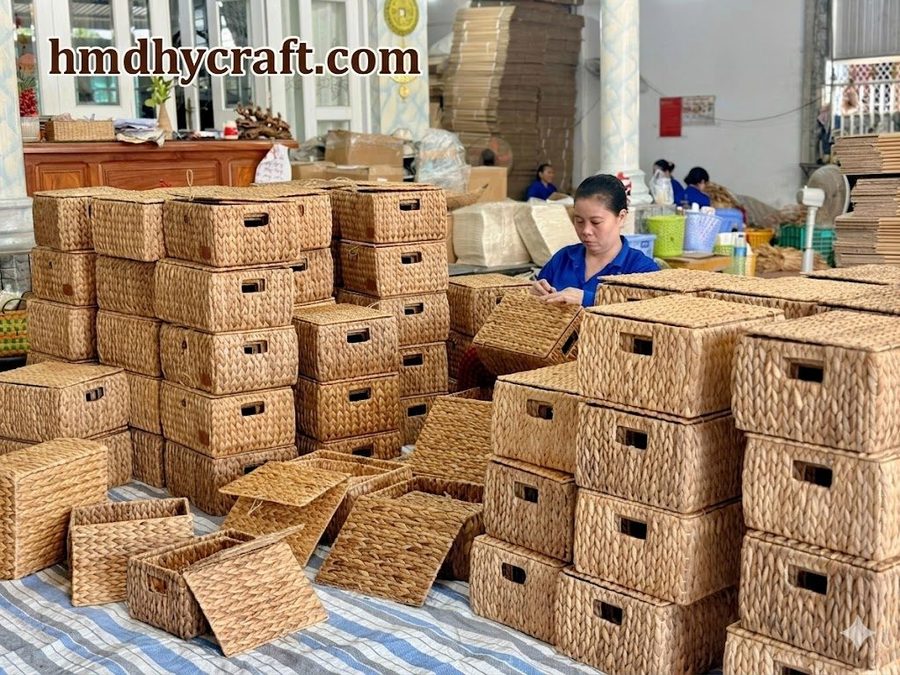
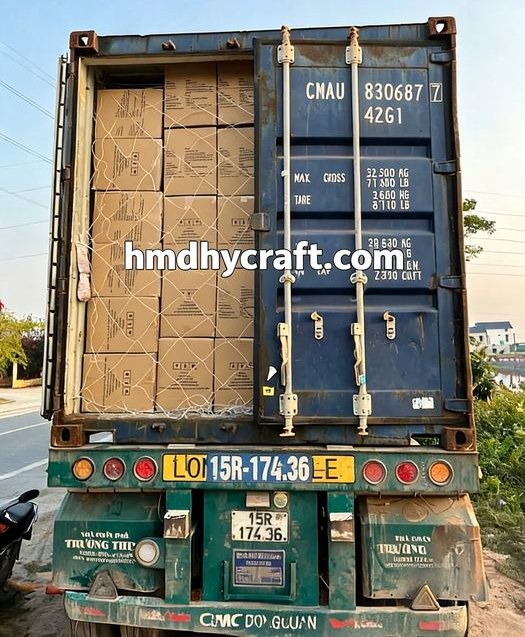
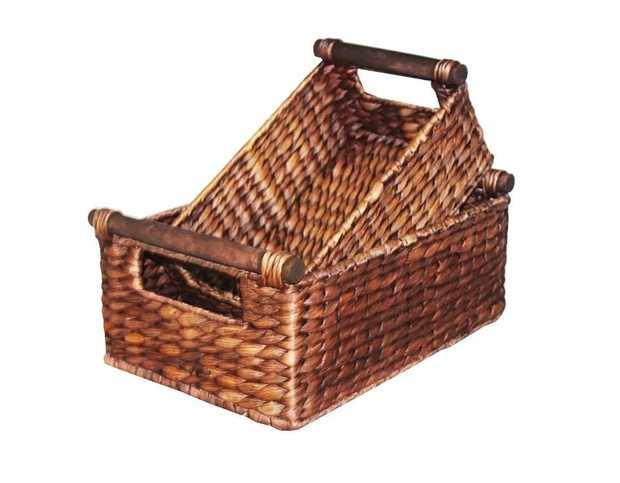
A container of handwoven water hyacinth baskets arrives at the buyer's DC with roughly 1,500 to 3,000 individually inspected pieces inside. Whether the buyer accepts the container, releases it to retail, and moves the invoice through their AP system depends on a small number of quality signals — most of them checkable in the first hour of receiving. This is the 14-point checklist HMD runs at pre-shipment, plus the pragmatic inbound audit the buyer's receiving team should sample against.
Written for wholesale buyers, DC receiving supervisors, and merchandising QA teams evaluating handwoven natural-fibre stock from Vietnam. The AQL sampling logic aligns with ANSI/ASQ Z1.4 (General Inspection Level II) which is the working reference used across the Vietnamese handicraft export sector.
The AQL context — what "acceptable" means for handwoven fibre
Handwoven baskets are not machine-made goods and no serious QC framework treats them as such. Every piece has small variances in weave tension, natural fibre colour, and finished dimension. The right question is not "are the baskets identical" (they never are) but "do the variances stay inside a band the retail customer accepts as normal for a handmade product."
HMD's default AQL for wholesale export inspection is AQL 2.5 for major defects and AQL 4.0 for minor defects, sampled per ANSI/ASQ Z1.4 General Inspection Level II. On a 300-piece SKU batch that means 32 pieces are inspected, and the batch passes if it has no critical defects, 2 or fewer major defects across the sample, and 5 or fewer minor defects. Stricter buyer standards (AQL 1.5 major) are quoted on request and typically add 4 to 7 percent to unit price to cover the tighter production discipline and higher rework rate.
| Defect class | Definition | Examples | Batch action |
|---|---|---|---|
| Critical | Safety hazard or unusable product | Sharp broken frame wire, mould contamination, unstable structural failure | Reject batch, rework, re-inspect |
| Major | Visible defect that would drive customer return | Dimensions out beyond ±3%, torn weave, obvious colour mismatch in set | Reject batch if AQL exceeded, sort-and-repair permitted |
| Minor | Cosmetic defect visible only on close inspection | Small loose end inside basket, mild uneven weave tension, minor natural fibre variance | Batch passes if AQL respected; noted in report |
The 14-point pre-shipment checklist
Every batch goes through these 14 checkpoints before HMD releases the container to load. The inspector is a senior HMD QC lead, working from a paper checklist per SKU, with dated photographs of the sample pool attached to the batch record.
1. Dimension check against buyer spec
Length, width, and height measured on 10 percent of the sample pool. Tolerance ±3 percent on any linear dimension. A 35 cm basket accepts 34 to 36 cm; any piece measuring 33.5 or 36.5 is flagged as major defect. Tape measure, not eyeballed.
2. Weave density check
Weave count per 10 cm span across the basket wall, measured on 5 percent of sample. Density must match the approved production sample within one thread per 10 cm. Below-spec weave means the basket wall flexes visibly under normal loading; above-spec means the buyer paid for tighter weave than they got.
3. Frame integrity check
Every metal-frame basket (typical for tall laundry hampers, magazine baskets, and iron-handle SKUs) is inspected for weld joint integrity by hand-flexing the frame. Any joint that gives visibly is a critical defect and pulled from the batch.
4. Fibre-end trim check
The interior of every sample piece is inspected under torch light for loose fibre ends that were not trimmed after weaving. This is the single most common minor defect on Vietnamese handwoven baskets and the single easiest to catch. Loose ends inside a storage basket rub against stored contents and read as poor finishing to the end customer.
5. Colour consistency within a set
For set-of-2 and set-of-3 SKUs, the two or three pieces in one set must show colour consistency to naked-eye inspection at 1 metre distance under D65 daylight. Different fibre batches used in one set is a common minor-to-major defect; caught early it is fixed by re-sorting sets from the same weaving batch.
6. Colour consistency across the run
Ten pieces from across the batch are laid out and compared under D65 daylight against the master approved sample. Batch colour is not required to be identical to master (natural fibre varies with harvest month) but variance beyond a defined swatch band is a major defect. Buyer receives approved swatch range with sample.
7. Finish uniformity (washed/lacquered SKUs)
Brown wash, black wash, white wash, and lacquer-finish SKUs are inspected for finish depth uniformity across the basket surface. Missed-spot finishing (a patch where the wash did not take) is a major defect on the affected piece.
8. Handle attachment check
Handled SKUs (wood-handle storage baskets, metal-handle laundry pieces) get a static load test on the sample pool. The handle is loaded to 1.5x the basket's rated load for 60 seconds. Any deformation or loosening is a critical defect.
9. Structural stability check
Empty basket must stand upright on its own base without rocking on a level surface. Rocking indicates uneven base weaving or frame misalignment. Load test to specified capacity confirms no visible sagging or shape distortion.
10. Anti-mould treatment verification
Every batch receives a food-safe fungicide treatment (sodium benzoate / calcium propionate spray) before packing. Verification is a visual check that the treatment log matches the batch record. Buyers requiring specific chemistry (typically for children's-nursery SKUs) receive the treatment MSDS on request.
11. Cleanliness inspection
Interior and exterior of every sample piece checked under torch for residual weaving debris, insect fragments, or unidentified matter. This is the checkpoint that catches the occasional cocoon or dead insect that survives the earlier stages. Zero tolerance — any piece flagged is pulled.
12. Packaging conformance
Carton dimensions, print, and content match the approved packing spec. SKU code, PO number, gross weight, net weight, dimensions, country of origin, and any buyer-specific labelling all cross-checked against the PO. Cartons with printing errors are re-printed at HMD cost.
13. Carton drop test
One in every 50 packed cartons is drop-tested from 60 cm onto a hard surface (simulates a warehouse pallet drop). Cartons that fail the drop test — visible internal damage on opening — are re-worked with heavier corrugation. This is standard for buyers with automated DC handling where drops are more frequent than manual handling.
14. Container load documentation
Photos of the loaded container from four internal angles plus door-side stack plus container plate with seal number. Container seal number, cartons per SKU, total CBM, and total gross weight logged on the load plan. Load plan and photo set travel with the shipping documents and are shared with the buyer's freight forwarder before booking.
What the third-party inspector adds (and does not add)
Buyers who need a formal third-party inspection typically appoint SGS, Bureau Veritas, or Intertek. The third-party inspector runs their own AQL sample against the same batch, produces an independent report, and photographs their sample pool. HMD arranges access to the consolidation warehouse and provides the SKU list, batch photographs, and load plan.
What the third-party inspector adds: independence, a report the buyer can file with their compliance team without HMD as the source, and a photo record the buyer's DC can reconcile against inbound audit. What the third-party inspector does not add: better technical inspection than HMD's own senior QC. The third-party inspector is running the same checklist against the same physical stock; their value is in signature independence, not superior technical judgement.
Third-party inspection fees are on the buyer's account and typically run $250 to $450 per inspection day. For most first-time programmes, HMD recommends third-party inspection on the first container as a baseline, then dropping to HMD's own senior QC for the second container onward once the buyer has calibrated their expectations against HMD's report format.
What the pre-shipment QC report contains
Every container ships with a pre-shipment inspection report covering: SKU list with quantity per SKU, sample size and sampling method per SKU, defect count broken down by severity (critical / major / minor), pass or fail decision per SKU and for the container as a whole, dated colour photographs of the sample pool per SKU, and the container load plan with cartons per SKU, CBM, and gross weight. Container photos and the seal number are attached separately once loading is complete. The report is emailed to the buyer within 48 hours of container departure from HCMC and travels as a signed hard copy with the physical shipping documents.
Inbound audit at the buyer's DC — the pragmatic sampling plan
The buyer's own inbound receiving audit does not need to replicate the full 14-point HMD checklist. It needs to sample enough that any systematic deviation from the pre-shipment report becomes visible before the container is released to retail. Here is a working audit that catches material problems without slowing the DC unload beyond one shift.
- Open 5 to 7 percent of cartons. On a 225-carton container, that is 12 to 16 cartons. Choose them randomly across the container, not just the door-side cartons — issues sometimes concentrate in the middle rows where visible inspection did not reach.
- Sample 3 to 5 pieces per opened carton. Total sample per audit: roughly 40 to 80 pieces across the container.
- Check the four highest-risk categories. Dimensions (tape measure), weave (visual against pre-shipment photo), colour consistency within sets (naked eye), and mould / visible moisture (touch + smell).
- Reconcile against the pre-shipment report. Match sample defect rate against the report's reported defect rate. If the audit finds a defect rate within 1 to 2 percentage points of the reported rate, the container is fit for release to retail floor. Beyond 2 percentage points, escalate.
- Photograph any defect found. A time-stamped photo with the carton reference and SKU is the artefact that either supports a claim against the supplier or documents that this batch was accepted as-is. Both records matter later.
- Document the audit outcome in the DC receiving log. Even a "no findings" audit needs a paper record. It matters six months later when a specific carton is queried for an end-customer return investigation.
The audit should take 90 to 120 minutes per container with a two-person receiving team. Buyers with automated inbound scanning can shorten this further; buyers with fully manual receiving in a smaller DC should build the audit into the container unload workflow rather than treat it as a separate step.
Handling a genuine QC dispute
Roughly 1 in 25 first-container programmes surfaces a QC dispute that needs resolution — usually a discrepancy between the pre-shipment report's defect rate and the buyer's audit findings. The HMD process for handling this:
The buyer photographs the discrepancy and sends the photos with carton reference and PO number within 5 working days of container arrival. HMD's QC lead reviews the photos, cross-references the original pre-shipment inspection record, and responds within 3 working days with either (a) acknowledgement of the defect and a proposed remedy — credit note, replacement in next container, or partial refund — or (b) a technical explanation of why the flagged pieces sit inside the agreed AQL band.
Genuine defect claims are settled by credit against the next order rather than by returning stock (return shipping costs typically exceed the value of the recovered stock). Chronic discrepancies across multiple containers are grounds for a joint review of the QC checklist and, if needed, a shift to third-party inspection on subsequent shipments.
The QC checklist is a contract, not a suggestion.
Buyers who invest 20 minutes in reviewing HMD's pre-shipment QC report on arrival, and 90 minutes in a proper inbound audit, resolve 95 percent of quality questions before they become disputes. Buyers who file the report unread and open the audit only after end-customer returns start climbing typically discover problems six weeks later, when the resolution options have narrowed and the stock is already on the shelf.
Frequently asked questions
What AQL standard applies to handwoven water hyacinth baskets?
HMD runs pre-shipment QC to AQL 2.5 major / AQL 4.0 minor, sampled per ANSI/ASQ Z1.4 General Inspection Level II. Stricter AQL 1.5 major is available on request, adds 4 to 7 percent to unit cost.
Who runs the pre-shipment QC — the workshop or HMD?
Both. Workshop runs continuous in-line QC during production; HMD's senior QC inspector runs an independent pre-shipment QC at HCMC consolidation warehouse, 48 to 72 hours before container loading. Third-party inspection is available on buyer request.
What are the most common QC defects on water hyacinth baskets?
Loose weave ends inside the basket (minor), dimension out of ±3% tolerance (major), and colour inconsistency within a set (minor to major). These three cover roughly 70% of QC rejections and all are catchable with tighter first-piece approval at the cooperative.
Does HMD provide a QC report per shipment?
Yes. Every shipment ships with a pre-shipment inspection report: SKU list, sample size, defect count and severity, pass/fail, dated photos of the sample pool, plus container load photos and seal number. Buyers use it for inbound audit reconciliation and insurance filing.
What tolerance applies to basket dimensions?
±3% on any linear dimension is the default. Stricter ±1.5% is achievable with a modest cost premium. Tolerances tighter than ±1% are not commercially achievable in handwoven work at wholesale prices; verify carefully any supplier promising them.
What does the buyer's inbound receiving audit need to check?
Open 5 to 7% of cartons randomly across the container, sample 3 to 5 pieces per opened carton, check dimensions / weave / colour / mould, reconcile against the pre-shipment report. Should take 90 to 120 minutes with a two-person team.