If this is your first Vietnam order, or if you have imported from Vietnam before and want to compare the process against how a proper exporter runs it, this is the walkthrough. Every step from first enquiry to container arriving at your port.
This piece is written for retail buyers, e-commerce category managers, and importers new to Vietnam sourcing. It covers what to send in a first enquiry, what a good FOB quote looks like, how sampling works, how payment terms are structured, what container packing looks like, and what documents you receive with the goods.
The eight-step import process
- Send a written enquiry with clear specification. Include reference images or a tech-pack, target dimensions (metric or imperial), finish preference, target quantity per SKU, destination port, and target unit landed cost. FOB quotes are only useful when the spec is clear.
- Receive an FOB quote and sample plan. A proper quote shows MOQ per SKU (usually 300 to 500 units for standard designs), FOB Ho Chi Minh City unit price per SKU, sample fee, sampling lead time (10 to 15 days), and production lead time (45 to 60 days for a full container).
- Approve the pre-production sample in writing. The sample is produced against your reference. You review dimensions, weave tightness, finish, packaging, and hangtag artwork. Written approval is what gates the production start.
- Place the PO and pay a 30 percent deposit. Standard payment terms are 30 percent T/T deposit against proforma invoice, 70 percent balance before B/L release. L/C at sight and open terms are available for repeat buyers.
- Production runs against the approved sample. Weaving cooperatives produce to spec. Mid-production photo or video check is standard. Third-party inspection (SGS, TÜV, buyer-nominated) can be arranged at your cost.
- QC, drying, and anti-mould treatment. Every unit is hand-inspected at the village and again at the HCMC packing facility. Moisture is dried below 15 percent. Eco-friendly anti-mould treatment prevents mould during ocean freight.
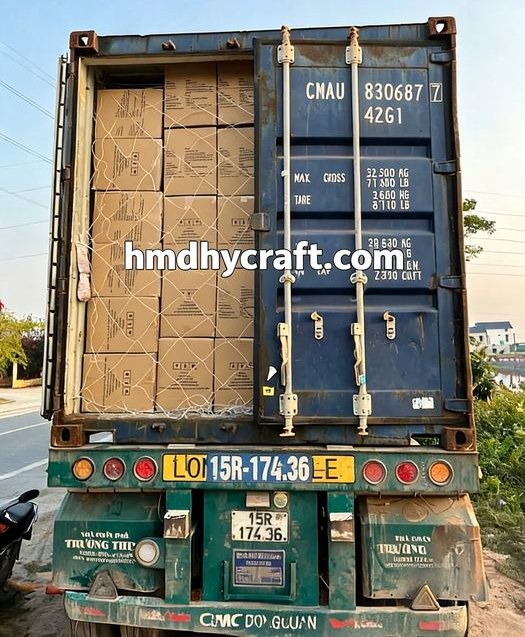
- Container loading FOB Ho Chi Minh City. Goods are consolidated at the HCMC facility. Loading is documented with photos and video. 20' or 40'HQ containers are loaded to your spec at Cat Lai or Cai Mep port.
- Documentation and B/L release. You receive commercial invoice, packing list, Certificate of Origin, phytosanitary certificate, and Bill of Lading. Balance payment is due before the B/L is released.
What FOB actually means
FOB (Free On Board) Ho Chi Minh City means the exporter's responsibility ends when the container crosses the ship's rail at the port of loading. From that point, ocean freight, marine insurance, destination clearance, and inland trucking are on you (or your nominated freight forwarder).
Alternatives you can request:
| Incoterm | Who pays ocean freight | Who handles destination clearance | Best for |
|---|---|---|---|
| FOB Ho Chi Minh City | Buyer | Buyer | Buyers with their own freight forwarder |
| CIF (Cost, Insurance, Freight) | Seller | Buyer | Buyers who want a single landed-at-port price |
| DAP (Delivered At Place) | Seller | Buyer clears; seller delivers | Buyers who want door delivery quoted |
| DDP (Delivered Duty Paid) | Seller | Seller | Rare for handicraft; complex duty risk on seller |
Most retail buyers on repeat programs prefer FOB and use their own freight forwarder for pricing consistency. First-time buyers often start on CIF to keep the quote simple, then move to FOB once they have a forwarder relationship in place.
HS code 4602 — what it covers
Handwoven natural-fibre baskets fall under HS chapter 4602 (articles of plaiting materials). The relevant subheadings for Vietnamese exports:
- 4602.19.90 — Basketwork of vegetable materials other than bamboo and rattan. This covers water hyacinth, seagrass, and mixed vegetable-fibre pieces.
- 4602.11.10 — Basketwork of bamboo.
- 4601.12.94 — Certain rattan articles (falls under 4601 not 4602).
Getting the HS code right on your commercial invoice matters. Wrong codes cause customs holds at destination. The exporter should confirm the code with you before the first shipment.
Container packing — 20' and 40' HQ
Typical packing capacity for handwoven baskets:
| Container | Volume (CBM) | Water hyacinth basket units (est.) | Rattan units (est.) |
|---|---|---|---|
| 20' standard | ~28 CBM usable | 500 to 800 | 350 to 500 |
| 40' standard | ~58 CBM usable | 1,000 to 1,500 | 700 to 1,000 |
| 40' HQ | ~68 CBM usable | 1,200 to 1,800 | 800 to 1,200 |
Actual count depends on SKU mix, nesting, and carton dimensions. Nesting sets (baskets that fit inside each other for shipping) can double the unit density of an individual-piece SKU. Discuss packing spec at PO stage, not at loading stage.
Documentation you will receive
Standard export documentation for handwoven baskets from Vietnam:
- Commercial invoice — issued by the exporter, shows HS code, unit price, incoterm, total value.
- Packing list — carton count per SKU, cartons per pallet if palletised, gross and net weight, container number.
- Bill of Lading (B/L) — issued by the ocean carrier, transfers cargo ownership. Released after balance payment received.
- Certificate of Origin — Form B (general), Form E (ASEAN-China), Form EUR.1 (EU under EVFTA), Form D (ASEAN), Form AI (India), Form AK (Korea), Form AJ (Japan), Form AANZ (Australia/NZ). Chosen based on destination country and trade agreement.
- Phytosanitary certificate — issued by Vietnam's Plant Protection Department. Required for most destinations because baskets are plant-based.
- Fumigation certificate — required for certain destinations (US, AU). Confirms wooden pallets meet ISPM-15 standard.
Common first-time buyer mistakes
Skipping the pre-production sample. "The first sample was fine, please go straight to production." Never do this. Pre-production sample is a separate, tighter round with your final materials, packing, and hangtag. Skipping it costs more than sampling ever will.
Vague spec. "Similar to this photo" gets you baskets that are similar to the photo. Send dimensions in numbers and finish references in physical samples where possible.
Choosing the cheapest quote without vetting. The cheapest quote is almost always from a supplier who has cut corners you cannot see until the container lands. See The cheapest supplier is usually the most expensive one.
Placing the first order in peak season. August through November is peak. Weaving villages fill up. Start your first program outside peak so the supplier can actually pay attention to your program.
Lead time in practice
The realistic timeline from first written enquiry to container arriving at a US or EU port:
- Enquiry to first FOB quote: 3 to 5 business days.
- Sampling: 10 to 15 days per sample round. Plan for two rounds unless your reference is exceptionally clear.
- Sample review and approval: buyer-side, typically 5 to 10 days.
- Deposit received to production start: 3 to 7 days.
- Production: 45 to 60 days for standard designs.
- QC, drying, packing, loading: 5 to 10 days.
- Ocean freight VN to US West Coast: 14 to 21 days.
- Ocean freight VN to EU/UK: 28 to 35 days.
- Destination clearance and inland: 3 to 10 days.
Total realistic timeline from first enquiry to warehouse: 100 to 130 days for a first order. Repeat orders on approved SKUs run 75 to 95 days because sampling collapses to a refresher round.
The cheapest way to shorten a lead time is to send a clear spec on the first day, not to chase for updates in week ten.
Every delay I have seen in six years traces back to the same root cause: ambiguity at the specification stage that surfaces during production. A precise brief up front is worth more than a fast supplier reply.