Container fill is the number that decides whether a first Vietnamese basket programme lands profitably. Get it wrong and either the buyer overpays freight per unit, or the container leaves HCMC with visible empty space above the last carton row. This guide walks through the actual maths — internal container volume, carton CBM, nesting ratios, and the trade-off between floor-loading and palletisation — with a worked example a buyer can copy against their own SKU list.
Written for buyers negotiating their first FCL container from Vietnam, category managers checking that a supplier's proposed load plan is realistic, and freight-forwarding coordinators handing off a container booking. Everything below is grounded in real HMD load plans from HCMC to Felixstowe, Long Beach, Barcelona, and Sydney over the last 18 months.
The container itself — what you have to work with
A 40-foot high-cube (40HQ) is the standard export container for handwoven basketry from Vietnam. Baskets are voluminous but light, so the container hits its volume ceiling long before it hits its weight ceiling. That is the exact opposite of a container of ceramics or a container of home appliances, and it changes how the load plan is built.
| Container | Internal L × W × H | Theoretical CBM | Practical CBM (baskets) | Max payload |
|---|---|---|---|---|
| 40' high-cube (40HQ) | 12.03 × 2.35 × 2.70 m | 76.4 CBM | 68 to 72 CBM | 28,600 kg |
| 40' standard | 12.03 × 2.35 × 2.39 m | 67.5 CBM | 60 to 64 CBM | 28,750 kg |
| 20' standard | 5.90 × 2.35 × 2.39 m | 33.0 CBM | 29 to 31 CBM | 28,180 kg |
| 45' high-cube | 13.55 × 2.35 × 2.70 m | 86.0 CBM | 77 to 81 CBM | 27,600 kg |
The "practical CBM" figure matters more than the theoretical one. Baskets ship in rectangular cartons; cartons stack in rectangular columns; columns leave gaps along the container ribs, at the door end, and above the last row where the ceiling is not flat. HMD's load plans target 68 CBM on a 40HQ as the practical working ceiling. Above 70 CBM the last row typically becomes a mixed-carton row that adds unload friction at destination.
Payload weight is rarely the constraint. A 40HQ full of nested water hyacinth storage baskets typically lands between 3,800 and 5,200 kg gross — roughly 15 to 18 percent of the container's payload limit. There is no reason to worry about weight distribution or axle limits on this cargo type.
Nesting — the single lever that changes everything
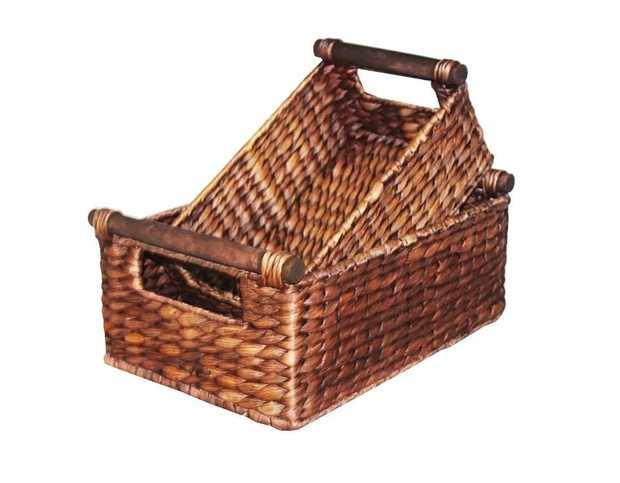
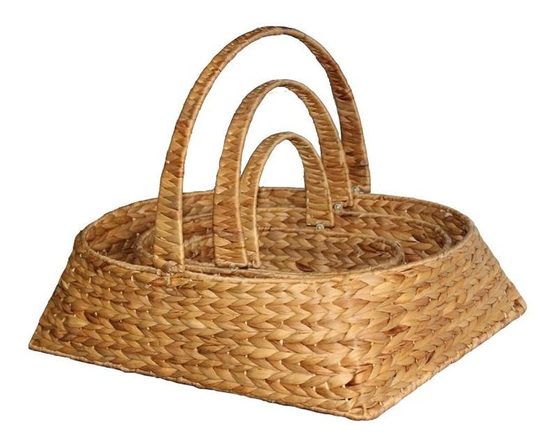
Nesting is the reason a container of water hyacinth baskets can hold 3,000 pieces where a container of rattan storage boxes holds 1,200. Handwoven baskets sold as sets (set-of-2, set-of-3, set-of-4) nest into each other during packing, so the outer carton dimension is only a little larger than the largest basket in the set. The smaller pieces essentially ship for free on the volume side of the equation.
The nesting ratio depends on the fit tolerance between sizes in the set. Water hyacinth allows tight nesting because the fibre gives slightly under load; the smaller piece can push against the walls of the larger without either warping. Seagrass nests less well because the tighter weave holds its shape more rigidly; a small piece pushed inside a larger seagrass basket leaves visible gaps.
| Set configuration | Individual basket CBM (largest) | Nested set CBM | Nesting ratio |
|---|---|---|---|
| Set of 2, water hyacinth storage | 0.028 CBM | 0.031 CBM | 1.11 × largest |
| Set of 3, water hyacinth storage | 0.045 CBM | 0.052 CBM | 1.16 × largest |
| Set of 4, seagrass tray | 0.019 CBM | 0.024 CBM | 1.26 × largest |
| Single, tall laundry hamper | 0.096 CBM | 0.096 CBM | 1.00 × (no nesting) |
| Single, magazine basket | 0.063 CBM | 0.063 CBM | 1.00 × (no nesting) |
A nested set of two water hyacinth storage baskets ships in roughly 1.11 times the volume of the larger basket alone. That means each set-of-2 SKU effectively delivers two pieces of retail inventory for a shade over one basket's worth of container space. It is the single reason set-based storage programmes are dramatically more freight-efficient than single-piece programmes.
Tall pieces do not nest. A tall laundry hamper, a magazine basket, an umbrella stand, or a floor planter each occupy their standalone volume in the container. A programme that mixes 20 percent tall pieces with 80 percent nested sets is a healthy freight balance. A programme that runs 60 percent tall pieces will fill the container much faster and ship many fewer retail units per B/L.
Cartons and export packing
HMD's default export carton is a five-ply corrugated box in dimensions that match the SKU. For a nested set-of-2 storage basket at 34 × 23 × 15 cm outer, the carton is typically 36 × 25 × 17 cm — a 2 cm allowance on each dimension for internal wrap. The carton weighs about 400 grams empty; the packed carton weighs 1.6 to 2.1 kg gross.
Every carton carries a printed label with SKU code, PO number, destination, gross weight, net weight, dimensions, and country of origin (Made in Vietnam). Barcoded labels are added on request for buyers with automated DC inbound scanning. Labelling is a packing-line task and adds no lead time; specifying the label format at PO stage avoids a hold-up at the QC gate.
Inside the carton, each nested set is protected by a single sheet of kraft tissue and secured with a paper band across the top. HMD does not use plastic wrap, foam beads, or bubble wrap on natural-fibre programmes. Buyers with sustainability commitments to plastic-free packaging get a certification-ready packing spec by default.
Worked example — a first UK retail container
Here is an actual HMD load plan from a first UK retail programme in early 2026. The buyer ordered five SKUs across storage, laundry, and bathroom, aiming for a comfortable partial 40HQ fill with room to add SKUs on the re-order.
| SKU | Design | Set | Qty (pieces) | Cartons | CBM/carton | Total CBM |
|---|---|---|---|---|---|---|
| HMD-001 | Storage basket, brown wash | Set of 2 | 300 (150 sets) | 25 (6 sets/ctn) | 0.186 | 4.65 |
| HMD-017 | Rectangular storage | Set of 3 | 300 (100 sets) | 25 (4 sets/ctn) | 0.208 | 5.20 |
| HMD-025 | Tall magazine basket | Single | 300 | 75 (4 pcs/ctn) | 0.252 | 18.90 |
| HMD-029 | Tall laundry hamper | Set of 2 | 300 (150 sets) | 75 (2 sets/ctn) | 0.192 | 14.40 |
| HMD-031 | Seagrass storage, liner | Set of 3 | 300 (100 sets) | 25 (4 sets/ctn) | 0.145 | 3.63 |
| Container fill | 1,500 pieces total | 225 cartons | 46.78 CBM | |||
The container ships at 46.78 CBM against a 68 CBM working ceiling — a 69 percent fill. That is the sweet spot for a first order: the buyer proves the assortment, the freight economics land within 12 percent of a full-container FOB, and there is room to add 4 to 6 more SKUs on the second container without needing to book a second FCL immediately. The gross container weight comes in at 2,940 kg, well inside the payload limit.
Note the shape of the fill. The two nested storage SKUs (HMD-001 and HMD-017) deliver 600 retail pieces in 9.85 CBM — the freight-efficient half of the container. The two tall SKUs (HMD-025 and HMD-029) deliver 600 pieces but occupy 33.30 CBM — three times the volume for the same unit count. That imbalance is fine on a mixed programme; it becomes a problem if the buyer scales up primarily on the tall SKUs, because the container fills much faster than the retail assortment expands.
Palletisation — when it makes sense and when it does not
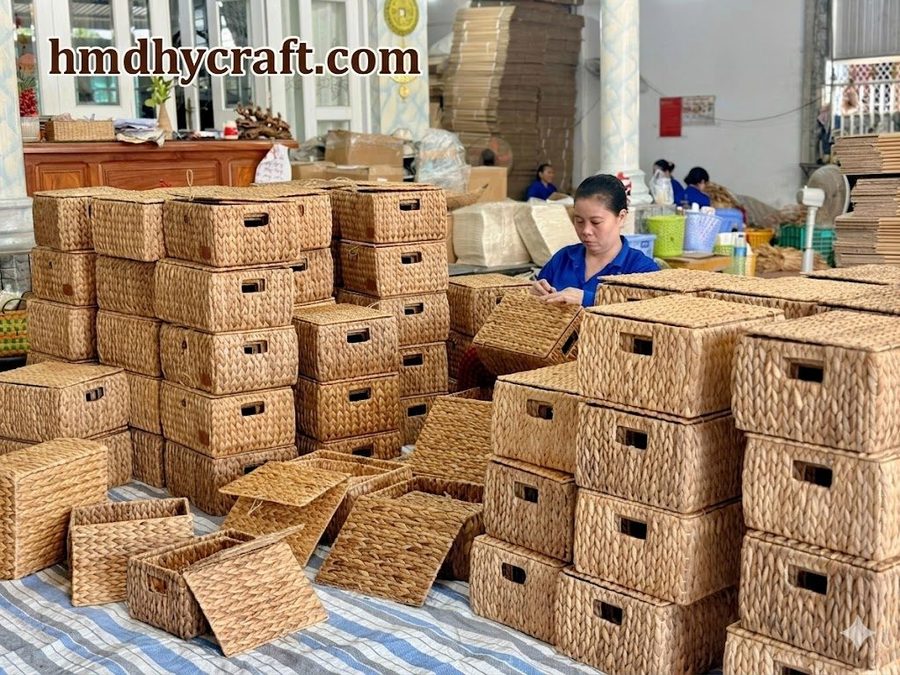
Floor-loading is the default for handwoven basket exports from Vietnam. Cartons are stacked directly on the container floor in interlocking columns, three to four columns wide across the container's 2.35 metre interior, and up to seven cartons tall depending on carton dimensions. This maximises volume utilisation and takes advantage of the fact that light basket cartons are safe to stack high.
Palletisation is available on request for buyers whose destination DC requires pallet-in entry (typically because the unloading dock is set up for a forklift-only workflow, not a manual belt loader). Palletisation trades volume for handling speed at destination. A standard EUR pallet (120 × 80 × 15 cm) with cartons stacked to 180 cm height carries roughly 1.4 CBM of packed cartons. A 40HQ holds 26 to 28 such pallets in a 2-across × 13-deep layout. Total container CBM drops to about 39, versus 68 for floor-loading.
The palletisation trade-off in one line
Palletisation costs roughly 42 percent of container volume in exchange for direct forklift unload at destination. On a first order at MOQ, that typically means 300 to 400 fewer retail pieces per container and a corresponding hit to landed cost per unit. On a repeat programme where the destination DC's unload speed matters more than the freight per unit, the trade often makes sense. On a first order, floor-load unless there is a specific DC requirement.
A middle option: slip-sheet loading. The container is floor-loaded onto slip-sheets rather than pallets, and a slip-sheet-capable forklift at destination pulls one slip-sheet at a time out of the container. This preserves most of the volume advantage of floor-loading while giving the DC operator a mechanised unload. It is the standard configuration for JYSK-style Nordic mass-retail programmes and is quoted on request.
Handing the load plan to the freight forwarder
HMD's default incoterm is FOB Ho Chi Minh City. The buyer nominates a freight forwarder; HMD delivers the sealed container to the forwarder's designated CY at Cat Lai or Cai Mep port; the forwarder handles ocean freight, destination clearance, and inland delivery to the buyer's DC. Under FOB the container becomes the forwarder's responsibility at the moment it crosses the ship's rail at HCMC.
The load plan is the handoff document. HMD provides it to the forwarder 3 to 5 working days before container booking. It contains everything the forwarder needs to file the export declaration and confirm the vessel booking: total cartons, total CBM, total gross weight, HS code (4602.19.90 for handwoven basketwork of vegetable materials), Form A certificate of origin reference, and container seal number as soon as issued. A copy of the load plan travels with the physical shipping documents.
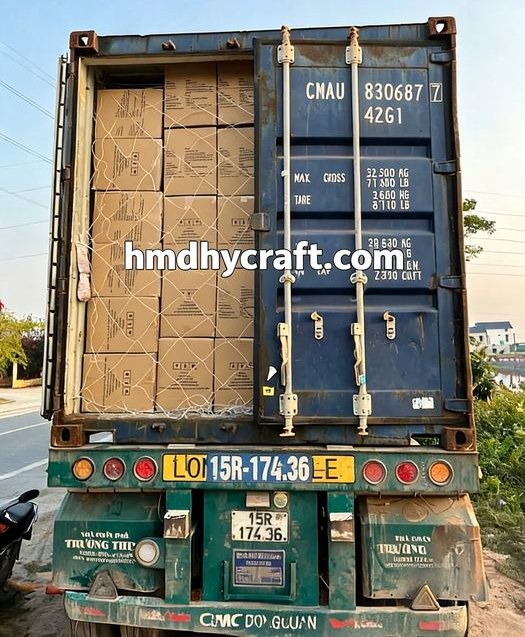
Photographs of the loaded container before the doors close are included in the standard document pack. The photo set covers the four internal walls, the ceiling, the door-side stack, and the container plate showing the seal number. Buyers with strict inbound receiving audits (Tesco, JYSK, Kohl's-tier retailers) file these photos against the arrival inspection. Buyers who never look at them still get them by default.
Volume is the constraint. Weight is the freeloader.
For any basket programme out of Vietnam, the container fills up on CBM long before it fills up on kg. Every load-plan decision — set-of-2 vs single, nested vs tall, palletised vs floor-loaded — is a CBM decision first and a weight decision approximately never. Optimise the volume side of the maths and the weight side takes care of itself.
Frequently asked questions
How many water hyacinth baskets fit in a 40HQ container?
2,200 to 3,000 nested storage baskets from HCMC, depending on set configuration and carton dimensions. Non-nesting pieces (laundry hampers, tall magazine baskets) drop the count to 1,400 to 1,800 pieces. A typical mixed-SKU first programme lands in the 2,000 to 2,700 range.
What is the CBM of a 40HQ container?
76.4 CBM theoretical internal volume. Practical working capacity, after allowing for carton stacking gaps and door clearance, is 68 to 72 CBM. HMD load plans target 68 CBM to leave a small buffer for dunnage and safe door-side stacking.
How is nesting ratio calculated for a set-of-2 basket?
The smaller basket sits inside the larger with roughly 60 to 65 percent of its volume displaced. The set nests to about 70 to 75 percent of the standalone volume of the larger basket, or roughly 1.11 × the largest basket's CBM as a shipped set.
Should I palletise or floor-load a container of baskets?
Floor-load unless the destination DC requires pallet-in entry. Pallets cost about 42 percent of container volume, which typically means 300 to 400 fewer retail pieces per container and a proportional hit to freight per unit.
Who is responsible for the container load plan?
HMD produces the load plan for FOB HCMC shipments and provides it to the buyer's nominated freight forwarder 3 to 5 working days before booking. Cartons per SKU, CBM per carton, gross weight, carton stack sequence, and loaded-container photographs are all included.
What is the container fill target for a first order?
45 to 55 CBM — roughly two-thirds of the 68 CBM working capacity of a 40HQ. That proves the assortment, leaves room to add SKUs on the re-order, and holds freight per unit within 12 percent of a full-container FOB.