Water hyacinth baskets are the workhorse of the natural-fibre home-decor category. They store, they hamper, they hold plants, they wrap gifts. They land at a price point that ships thousands of units per SKU without eating the buyer's margin. This page is the reference we give to first-time HMD Hycraft buyers who want to understand the material, the types, the trade-offs against seagrass and rattan, and the practicals of moving a container from the Mekong Delta to their DC.
On this page
- What a water hyacinth basket is
- Water hyacinth basket manufacturer in Vietnam
- Types of water hyacinth baskets
- Water hyacinth vs seagrass, rattan and bamboo
- Sustainability and the invasive-species story
- Quality control and supply chain
- Wholesale, bulk export and supplier terms — MOQ, lead time, container maths
- Container load maths for water hyacinth basket bulk export
- Care and maintenance
- Featured SKU shortlist
- Frequently asked questions
What a water hyacinth basket is
Water hyacinth (Eichhornia crassipes) is a floating freshwater plant with round leaves and lilac flowers. It grows aggressively across the Mekong Delta in southern Vietnam, forming dense mats on rivers, canals, and shrimp ponds. Left alone it clogs waterways and starves fish habitats of oxygen. Harvested, dried, and twisted into rope, it becomes the raw material for one of Vietnam's largest handicraft export categories.
To make a basket, artisans cut the stems close to the waterline, tie them into bundles, and sun-dry them for three to five weeks depending on weather. The dried stems are then split, twisted, or braided into ropes ranging from thin cord to thumb-thick cable. Those ropes are woven over a shape-holding frame — a bent metal wire on a laundry hamper, a rattan hoop on a round nesting basket, or a wooden ring on a magazine holder. Finishing is a series of quiet steps: trim, brush, oven-dry to below fifteen percent moisture, treat against mould, and cool before packing.
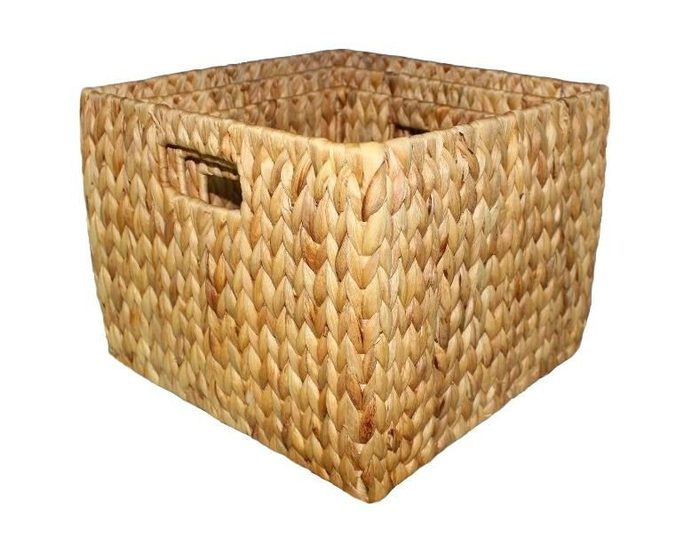
The finished basket is light, breathable, and warm-toned. It sits at a lower price point than rattan or wicker, holds shape better than seagrass under load, and takes buyer-specified dyes and washes cleanly. Retail buyers select water hyacinth for storage baskets, laundry hampers, nursery bins, planter holders, magazine baskets, gift hampers, tray sets, and low-decor floor pieces. E-commerce buyers add utility SKUs like nested sets and stackable cubes.
Water hyacinth basket manufacturer in Vietnam — the HMD cooperative network
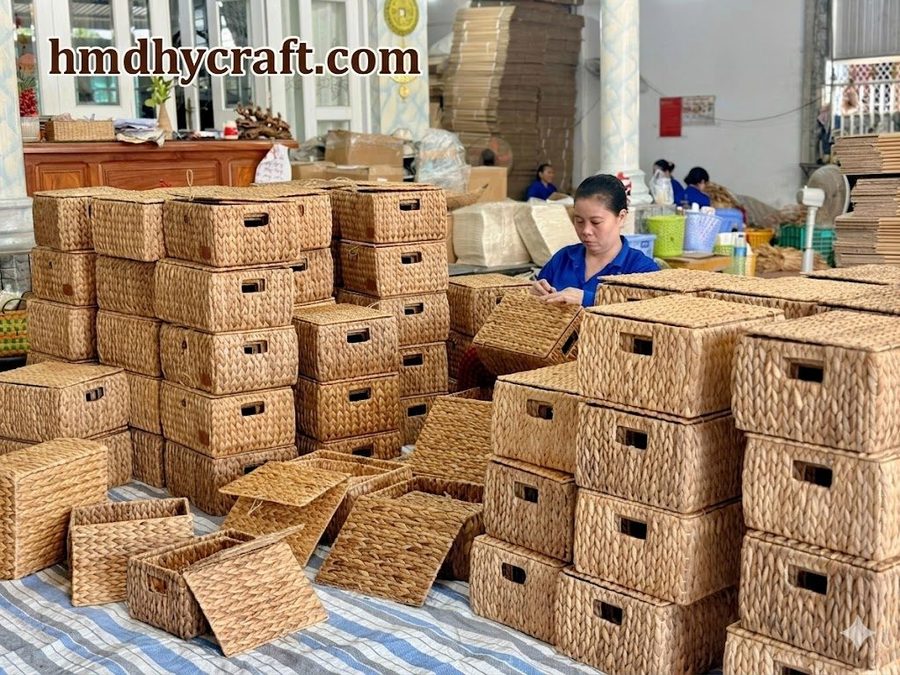
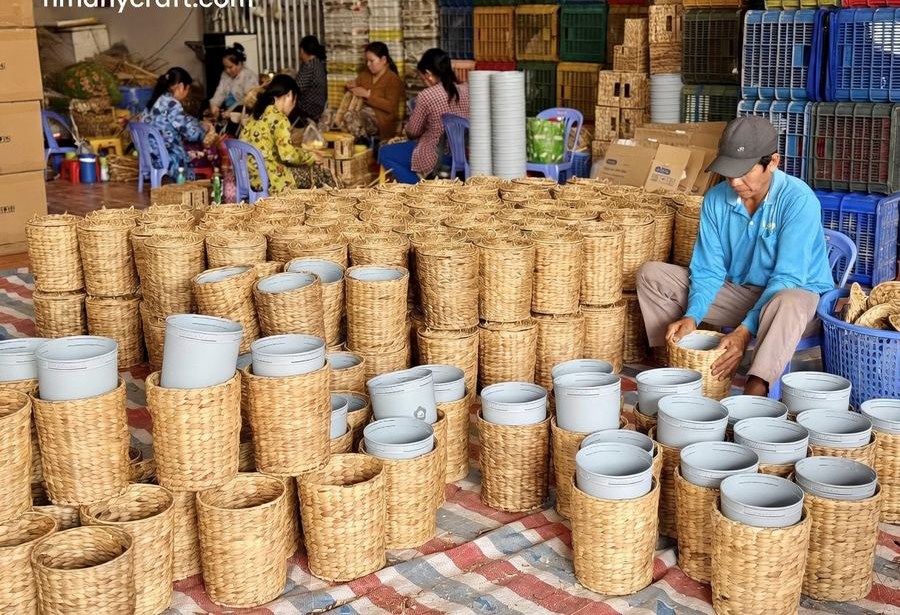
Wholesale buyers usually ask early whether HMD Hycraft is a factory or a trader. Neither is quite right. Water hyacinth basket manufacturing at scale in Vietnam is not a single-roof factory business — it is a cottage-craft network. HMD operates as the coordinating manufacturer for a group of BSCI-audited weaving cooperatives across Đồng Tháp, Bến Tre, and neighbouring Mekong Delta provinces. HMD owns the export licence, the quality control, the anti-mould treatment, the container consolidation, and the buyer relationship. The cooperatives own the weaving benches, the artisan labour, and the drying yards.
What this means for a wholesale buyer is straightforward. You place one PO. HMD writes the production breakdown across cooperatives by SKU and by capacity, oversees pre-production sampling, runs in-line QC visits, kilns the finished pieces at the HMD facility outside Ho Chi Minh City, treats them against mould, and consolidates them into your container. You get one supplier of record, one commercial invoice, one B/L, and one point of accountability. You do not chase four workshops for four sub-orders and reconcile four packing lists.
HMD has run this model since 2019 for retail programmes ranging from three-hundred-piece test orders for indie European home-decor brands up to multi-container annual programmes for larger buyers. Compliance sits on top: BSCI-audited weaving partners as the baseline; SEDEX and BRC-Consumer Products audits are arrangeable through nominated third-party auditors when the buyer's programme requires them. OEM and private label are standard: HMD produces to buyer-supplied CADs, samples with the buyer's Pantone reference, and prints buyer-branded hang-tags and cartons on request.
Types of water hyacinth baskets
The Storage Baskets Collection 2026 organises HMD Hycraft's water hyacinth range into eight functional categories. Most retail programmes draw from two or three of these categories to give shoppers a coherent shelf story.
- Storage baskets and nested sets. The volume category. Square, rectangular, oval, and round shapes in single-piece or nested-set formats (usually sets of two, three, or four). Common lids: open top, cotton-lined open top, cloth-flap closure. Best for closet organisation, playroom shelves, and open-shelving retail displays.
- Laundry hampers. Taller pieces with a wire or bamboo internal frame and often a lift-off lid. Two-piece sets sell well in North American bathroom programmes. Interior cotton liners protect delicates.
- Nursery and toy storage. Softer weaves, rounded edges, and lower profile heights matched to shelf systems from Ikea, Kallax, and similar. Retailers who ship children's ranges appreciate the anti-mould treatment being non-toxic.
- Planter baskets and cachepots. Cachepot sleeves that fit standard nursery pot sizes (four, six, eight, ten, twelve inches). Water hyacinth's tolerance of humidity makes it a strong fit for the indoor-plant market.
- Magazine and floor baskets. Tall vertical formats with rounded openings, sometimes with a folded lip. Used as a hallway umbrella stand, a fireplace kindling holder, or a magazine caddy next to a reading chair.
- Trays and shallow bowls. Rectangular and oval trays with woven handles. Popular in gifting programmes as a base under artisan food or wellness kits.
- Gift hampers. Structured hampers with a hinged lid, ribbon-tie closures, and a cotton or gingham interior lining. Widely used across European Christmas programmes and Latin American cesta gifting.
- Home decor pieces. Non-utility SKUs — decorative floor pieces, lantern-shape hurricanes, wall baskets, plant hangers. These sit above the utility range on price and open the door to a fuller room story.
All eight categories are available in the natural water-hyacinth colour and in a small range of dye washes — brown wash, white wash, black, and a warm charcoal grey. Custom colourways are quoted per project against a Pantone reference.
Water hyacinth vs seagrass, rattan and bamboo
Buyers who are new to natural-fibre baskets often ask which material to specify. There is no single winner. Each has a strength and each has a fair use case. A retail buyer usually specifies a mixed programme across two or three materials to create a natural collection that reads coherent on the shelf.
| Material | Feel | Colour | Best for | Weak against | Price index (WH = 100) |
Container fit |
|---|---|---|---|---|---|---|
| Water hyacinth | Soft, warm, springy | Even beige-brown; takes wash dyes cleanly | Storage, laundry, gift hampers, planters, nursery | Hard-edge geometric patterns (softness limits pattern) | 100 | Excellent — nests tightly (2,200 to 3,000 pcs / 40'HQ) |
| Seagrass | Coarser, stiffer, cooler | Greenish beige, uneven | Coastal-look decor, rope handles, floor pieces | Nursery (rougher texture on skin) | 115 to 125 | Very good — nests well when shape allows |
| Rattan | Hard, glossy | Golden yellow to warm brown | Fine weave patterns, furniture, chairbacks | Casual utility storage at value price | 130 to 150 | Fair — rigid, low nesting efficiency |
| Bamboo | Hard and rigid | Pale beige to dark carbonised | Frames, boxes, food-service SKUs | Soft-touch retail programmes | 110 to 130 | Fair to poor — rigid frames, minimal nesting |
Water hyacinth's real advantage is value density per container. A forty-foot high-cube container carries roughly 2,200 to 3,000 water hyacinth baskets in a mixed nested programme, at a wholesale price point that lets retail buyers hit their preferred markup without cutting corners on weave quality. Seagrass and rattan are typically 15 to 30 percent more expensive per equivalent unit, which pushes retail price up and sales velocity down.
Sustainability and the invasive-species story
Water hyacinth is one of the world's most aggressive invasive aquatic weeds. It doubles its biomass in eight to twelve days, forms mats several metres thick, blocks navigation and fishing routes, and starves fish habitats of dissolved oxygen. Governments across South-East Asia, Africa, and Latin America spend serious money each year attempting to control it.
Harvesting water hyacinth for craft simultaneously solves two problems: it removes the pest and it supports rural livelihoods. In Đồng Tháp Province alone, the weaving cooperatives HMD works with employ several thousand women, many working from home. The plant regrows within weeks, so there is no depletion risk on the input side and no reason to switch to synthetic substitutes. The finished basket is 100 percent biodegradable — when it eventually retires, it composts back into the soil rather than sitting in landfill for four hundred years.
From a carbon perspective, the material is close to neutral. The plant absorbs CO₂ during growth. Drying is powered by tropical sunlight rather than gas or grid electricity. Ocean freight is the largest carbon line in the finished landed cost, but a full container of natural-fibre baskets displaces several containers of plastic storage bins that would otherwise be shipped from petrochemical-heavy supply chains. Retail buyers who care about scope-3 emissions can point to a defensible story here without greenwashing.
Quality control and supply chain
HMD Hycraft is an export intermediary, not a factory. Handwoven water hyacinth is a cottage craft — no single factory produces it at industrial scale. What HMD provides is quality control, export compliance, and logistics across a trusted network of BSCI-audited weaving cooperatives in Đồng Tháp Province. That intermediary role is deliberate: it lets buyers place one order and receive one container of consistent goods without having to build a supplier network of their own inside the Mekong Delta.
Where the quality risk sits
Three risks matter for a buyer moving water hyacinth baskets:
- Moisture and mould. Baskets dispatched above 15 percent internal moisture will grow mould in the container during the 30 to 45 days of ocean transit. HMD dries every unit at HCMC and applies an eco-friendly anti-mould treatment. Buyer's inspection at the DC should find zero mould claims across a container.
- Dimensional drift. Handwoven work has natural tolerance. HMD holds tolerance at ±5 percent on height and diameter against the approved sample; anything above that is rejected at the packing stage.
- Weave discipline. Loose or uneven weave is a village-level issue. HMD's field team visits partner workshops during production to catch drift early. A retail buyer who cares about visual consistency can nominate a third-party auditor (SGS, Bureau Veritas, or the buyer's own team) at any stage; audit fees are on the buyer's account.
Compliance and certification
Water hyacinth baskets classify under HS 4602 ("plaiting materials, other than of vegetable materials"). Phytosanitary certificates and Certificate of Origin (Form A, Form B, Form E, or Form EUR.1 depending on destination) are issued through Vietnam Customs before B/L release. Anti-mould treatment is compliant with import regulations for the EU, UK, US, Canada, Australia, Japan, and South Africa. Workshop partners are BSCI-audited; SEDEX and BRC-Consumer Products audits can be arranged through nominated third parties.
Wholesale, bulk export and supplier terms — MOQ, lead time, container maths
The practicals of moving a container are usually where a first buyer wants numbers, not narrative. Here is the short version.
MOQ
Standard SKUs from the Storage Baskets Collection 2026 start at 300 to 500 units per SKU. Mixed containers with several SKUs are welcomed and often more practical for a first order. Custom sizes and colourways add a sampling window of two to three weeks.
Lead time
Standard lead time is 45 to 60 days from confirmed PO and approved pre-production samples. That includes cottage drying (weather-dependent), weaving, framing, kiln-drying to below 15 percent moisture, anti-mould treatment, packing, and container consolidation at HMD's HCMC facility. Peak-season windows (August to November) may extend by 10 to 15 days as village capacity peaks.
Container maths
A 40'HQ container has an internal volume of roughly 76.4 m³. Nested set programmes ship efficiently because the smaller pieces sit inside the larger ones — a set-of-3 nested basket takes only slightly more volume than the largest piece alone. Single-piece programmes (laundry hampers, floor baskets) fill the container faster on volume but often before hitting weight limits. HMD provides a container load plan with cartons per SKU, palletisation option, and pre-shipment photos before B/L is issued.
Payment
Standard terms are 30 percent deposit against proforma invoice and 70 percent balance before B/L release, by T/T. For repeat buyers, L/C at sight or open terms can be discussed on a case-by-case basis. Invoicing is in USD or EUR. HMD does not accept cryptocurrency for wholesale invoices.
Container load maths for water hyacinth basket bulk export
Wholesale programmes moving water hyacinth baskets out of Vietnam ship in 40-foot high-cube (40'HQ) containers, not by air. Ocean freight is the only economical route for a category where weight is negligible and volume is the binding constraint. A 40'HQ has an internal volume of roughly 76.4 m³ and a payload ceiling of about 29 tonnes — but a container of finished water hyacinth baskets rarely exceeds 3 tonnes, so weight is never the limit. Volume is.
Typical container loads for water hyacinth basket bulk export from Ho Chi Minh City:
- Nested-set programmes (set of 2, 3, or 4 storage baskets): 2,200 to 3,000 pieces per 40'HQ. Nesting is the reason natural-fibre baskets ship efficiently — the smaller pieces sit inside the larger ones, so a set of three occupies only slightly more volume than the largest piece alone.
- Single-piece programmes (laundry hampers, floor baskets, planter cachepots): 1,400 to 1,900 pieces per 40'HQ.
- Mixed programmes (three to eight SKUs across storage, laundry, and decor): typically 1,800 to 2,500 pieces per 40'HQ depending on the ratio of nested to single-piece.
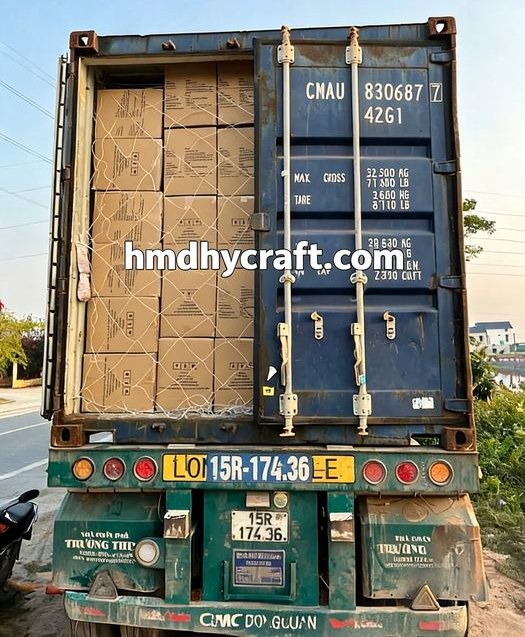
HMD Hycraft provides a container load plan before B/L release. The plan lists cartons per SKU, palletisation option (Euro pallet 1.2 × 0.8 m, US pallet 1.2 × 1.0 m, or floor-loaded), export cartons dimensions, gross weight, and pre-shipment photos of the loaded container. Buyers who need to pre-book DC receiving slots get the load plan two to three days before container gate-in at Cat Lai or Cai Mep.
Documentation released with the container: commercial invoice, packing list, ocean B/L, phytosanitary certificate, Certificate of Origin (Form A for GSP-eligible destinations, EUR.1 for the EU-Vietnam FTA, Form B for the US, or Form E for ASEAN), and — where the buyer or their forwarder specifies — fumigation certificate or ISPM-15 stamp on wooden crating.
Ocean transit from Ho Chi Minh City is 24 to 28 days to the US East Coast, 30 to 34 days to the US West Coast via transhipment, 18 to 22 days to Northern Europe (Rotterdam, Hamburg, Antwerp), 14 to 18 days to the UK (Felixstowe, Southampton), 22 to 26 days to Melbourne, and 24 to 28 days to Durban. Add three to seven days for inland trucking depending on DC location. Freight is the buyer's forwarder unless CIF or DAP is quoted specifically in the proforma.
MOQ + container calculator
Plug in your programme size below to see the number of 40'HQ containers required, the MOQ compliance check per SKU, and the lead-time framing. The averages match the pieces-per-container numbers set out above; the calculator is a first-pass planning tool, not a firm quote.
Enter your numbers to see the container count, MOQ check, and lead time.
Care and maintenance for the end consumer
The retailer's care card can lift much of this straight into the box. Water hyacinth baskets look after themselves if the end consumer follows a short list of do's and don'ts.
- Keep dry, ventilated, and out of prolonged direct sunlight. Sunlight will fade the natural colour over months; occasional exposure is fine.
- Wipe with a soft dry cloth or a lightly damp cloth if soiled. Never submerge in water and never machine wash. Standing water will loosen the weave.
- Keep away from radiators, ovens, and permanently humid corners (behind toilet cisterns, bathroom floor near a shower).
- If a basket feels slightly damp after a wet season, air it in a shaded outdoor spot for a few hours until dry.
- Use a cotton or linen liner for laundry hampers if soiled damp clothes will sit inside for hours.
- A gentle spray of vinegar-and-water once a year discourages mould in high-humidity homes.
With basic care, a water hyacinth basket lasts five to ten years of daily use and takes on a gently darker patina over time.
Featured SKU shortlist
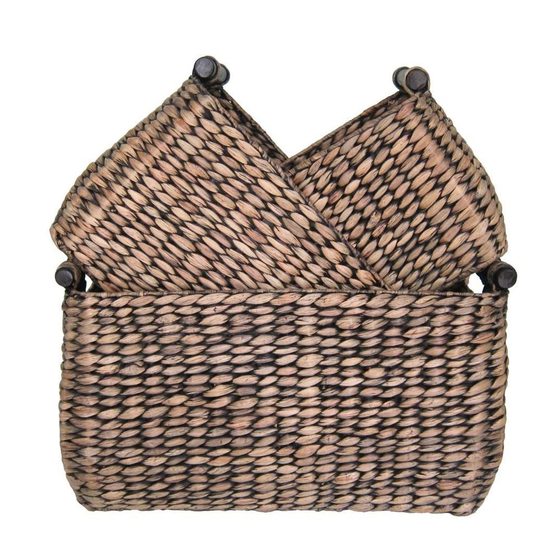
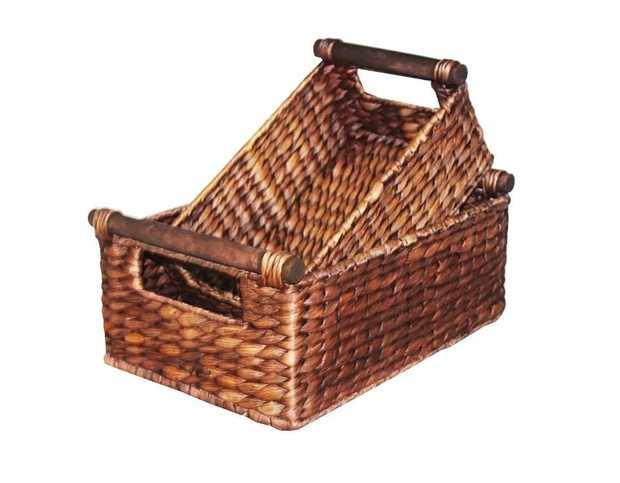
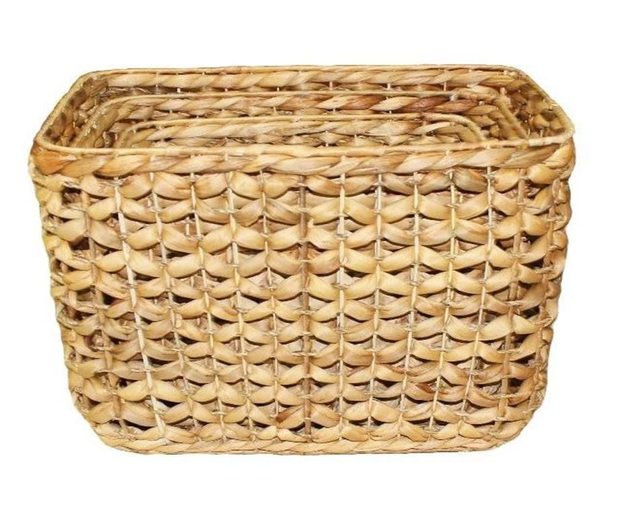
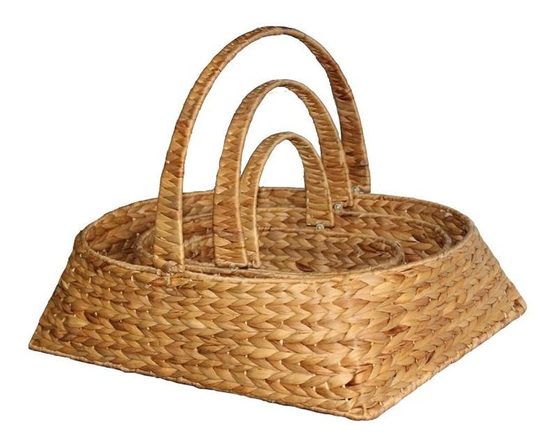
These are the top-moving water hyacinth SKUs from the Storage Baskets Collection 2026. Every SKU ships with a hi-res product photo on a neutral background and at least one styled lifestyle image.
The full Storage Baskets Collection 2026 covers 14 water hyacinth and seagrass SKUs. A first-order buyer typically picks four to seven SKUs to fit a 40'HQ container. See the Uses hub to browse SKUs organised by end-use application: bathroom, laundry, nursery, planters, gift hampers, magazine and office, plus buyer-market landings for UK home retail, Nordic DIY, and Spanish hamper catalogue programmes.
Frequently asked questions
What is a water hyacinth basket?
A handwoven basket made from the dried stems of the water hyacinth plant. Fast-growing, freshwater, aquatic. Vietnam's Mekong Delta is the leading source. Handwoven over a metal or rattan frame, then dried and treated for export.
Where do the best water hyacinth baskets come from?
Vietnam's Mekong Delta — Đồng Tháp, An Giang, and Kiên Giang provinces — is the leading global source. Longer, more uniform fibres and tighter weave discipline than Indonesian or Philippine alternatives. HMD Hycraft sources exclusively from BSCI-audited cooperatives in Đồng Tháp.
What is the MOQ for wholesale water hyacinth baskets?
MOQ starts at 300 to 500 units per SKU on standard designs. Mixed containers with several SKUs are welcomed. Custom sizes or colourways may require larger MOQ for sampling economics.
How long does production take?
Standard lead time is 45 to 60 days from PO and approved samples. Peak-season (August to November) may add 10 to 15 days.
Are water hyacinth baskets eco-friendly?
Yes. Water hyacinth is an invasive weed — harvesting it removes an ecological pest and supports rural livelihoods. The finished basket is 100 percent biodegradable and uses no petrochemical inputs.
How do these compare to seagrass, rattan and bamboo?
Water hyacinth is softer, warmer, and cheaper per container. Seagrass is coarser and cooler. Rattan is harder and better for fine patterns. Bamboo is the hardest and best for rigid frames. Most retail programmes mix two or three materials.
How should end-consumers care for the basket?
Keep dry and ventilated. Wipe with a soft cloth. Never submerge. Air-dry if damp. Five to ten years of daily use is realistic with basic care.
Does HMD Hycraft handle private label?
Yes. Custom dimensions, weave patterns, colour references, buyer-branded hangtags, care labels, retail packaging, and gift boxes. Sampling starts when the tech pack and reference images are shared.
What are the payment terms?
30 percent deposit against proforma invoice, 70 percent balance before B/L release, T/T. USD or EUR. L/C at sight or open terms discussed for repeat buyers.
Which countries does HMD export to?
US (largest destination for HS 4602 globally), UK, EU (Germany, Denmark, Spain, Poland, France), Australia, Japan, South Africa. FOB Ho Chi Minh City. CIF and DAP quoted on request.