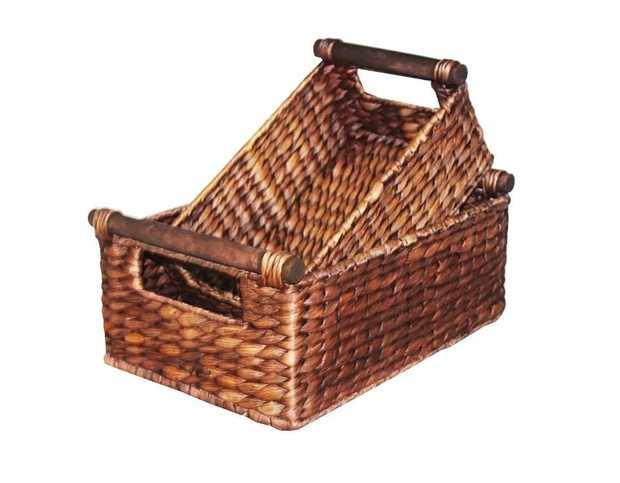
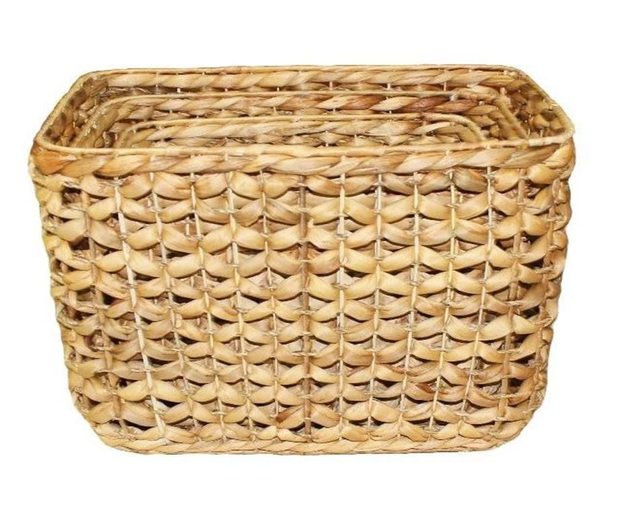
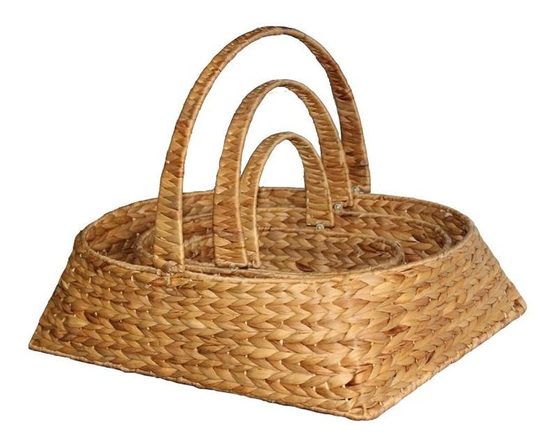
Water hyacinth and seagrass are the two most-requested natural fibres out of Vietnam. In a lookbook they read as interchangeable. In a container, in the retail warehouse, and on the shelf, they behave nothing alike. If your programme has room for one and not both, this is the comparison that saves you a sample round.
Written for wholesale buyers, e-commerce category managers, and private-label programmes sourcing natural-fibre home décor from Vietnam. It covers what each fibre actually is at the botanical level, where each holds shape and where each does not, the honest price and lead-time gap, and how retailers typically pair them in a single programme rather than picking one over the other.
What each fibre actually is
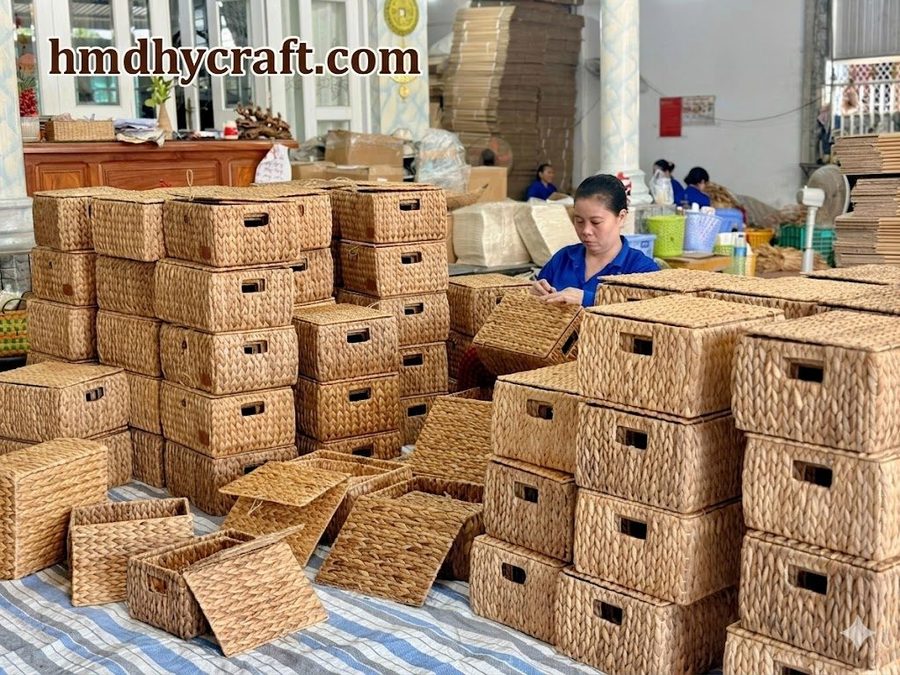
Water hyacinth (Eichhornia crassipes, or lục bình in Vietnamese) is a floating freshwater plant with round leaves and lilac flowers. It grows aggressively across the Mekong Delta in southern Vietnam, forming dense mats several metres thick that clog rivers, canals, and shrimp ponds. Harvesting is a small-boat operation: artisans cut the stems close to the waterline, tie them into bundles, and sun-dry them for three to five weeks depending on weather. The dried stems are then split, twisted, or braided into ropes ranging from thin cord to thumb-thick cable, and woven over a shape-holding frame.
Seagrass (cói) is a member of the sedge family that grows in coastal marshland in north-central Vietnam — Ninh Bình, Thanh Hóa, and Nga Sơn are the historical production heartlands. The fibre is finer and rope-like once dried, and it holds tension when woven tight. Buyers frequently confuse seagrass with grey sedge (a coarser marsh grass used for mats), so it is worth confirming the exact fibre on any first sample order.
Two very different botanical starting points, two very different harvest cycles, two different regions of the country. That is why the fibres cost differently and behave differently, before you even start weaving.
The comparison at a glance
| Attribute | Water hyacinth (lục bình) | Seagrass (cói) |
|---|---|---|
| Source | Freshwater weed, Mekong Delta | Coastal marsh sedge, north-central Vietnam |
| Fibre character | Chunky, soft, spongy to touch | Fine, rope-like, cool to touch |
| Natural colour | Warm tan, honey brown, even | Cool grey-green, natural straw, uneven |
| Holds shape best in | Large storage, laundry, floor pieces, hampers | Flat trays, structured smaller baskets, table décor |
| Typical FOB price per unit | Baseline | +15 to +25 percent |
| Standard lead time | 45 to 60 days | 50 to 65 days |
| Finish options | Natural, brown wash, black wash, white wash | Natural, black dye, dip-dyed accents |
| Container fit (40'HQ nested) | 2,200 to 3,000 pieces | 1,800 to 2,600 pieces |
Where water hyacinth wins
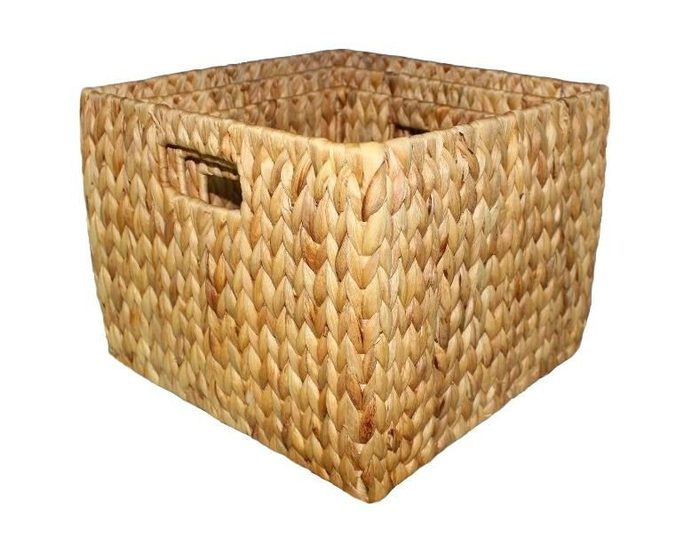
Water hyacinth is the volume material of Vietnamese natural-fibre exports for good reason. The stem is thicker and springier than seagrass, which gives a woven basket enough body to stand upright empty without a rigid frame. That opens up the categories buyers actually order in the largest volumes.
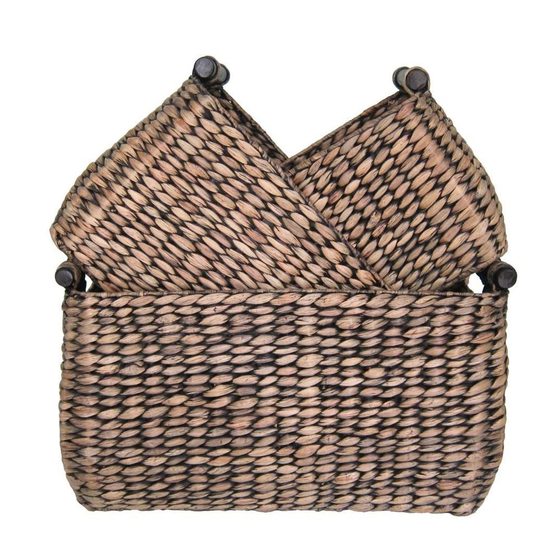
- Storage baskets, set-of-2 and set-of-3. The fuller fibre lets the basket carry its own shape from empty to fully loaded without a wire cage inside. This is the biggest single category for water hyacinth exports out of Vietnam.
- Laundry hampers. Breathes well, so damp cotton and towels do not stagnate against the weave. Lightweight when full, which matters for taller pieces that get lifted repeatedly. Two-piece sets sell well in North American bathroom programmes.
- Floor baskets, magazine holders, umbrella stands. Warm tone works in living-room contexts and reads softer than rattan or bamboo. The larger scale of these pieces is where water hyacinth's shape retention actually matters most.
- Gift hampers and seasonal SKUs. Takes brown wash, black wash, and white finish cleanly. Widely used across European Christmas programmes and Latin American gift-basket seasons.
- Planter baskets and cachepot sleeves. Water hyacinth tolerates the incidental humidity of indoor plant care better than most drier fibres.
The category ceiling for water hyacinth is around 6.5 kg of finished weight per piece before the fibre needs a metal or rattan hoop to hold structure. That covers effectively every retail storage and laundry SKU on the market.
Where seagrass wins
Seagrass is the fibre I recommend when the piece has to look precise, not just handmade. The rope-like fineness of the fibre and the tight weave discipline it demands give seagrass a cleaner finished edge and a more level surface than water hyacinth can hold at small scale.
- Flat trays and serving pieces. Tight weave gives a flat, level surface. Water hyacinth's chunkier weave makes an uneven tray base that catches on cloth napkins and drink bases.
- Small structured baskets and organiser cubes. Dimensions stay square through shipping and warehouse handling. Water hyacinth relaxes about 3 to 5 percent over a long sea leg, which is fine on a laundry hamper but visible on a 20 cm cube.
- Place mats, coasters, table runners. Weave finishes cleanly at the edge without fraying. Retailers stocking dining SKUs almost universally specify seagrass here.
- Pieces where colour matters. Seagrass takes black dye and dip-dyed accents better than water hyacinth. The cool natural tone provides a neutral base that dye colours read clearly against.
- Coastal-look and Mediterranean décor programmes. The green-grey natural tone reads as "sea" in a way the warm tan of water hyacinth does not.
Seagrass is not the right fibre for oversized laundry or floor pieces. The fibre is not full enough to stand up unaided at that scale, and adding a stiff internal frame to make it work often costs more than switching to water hyacinth would.
The honest price and lead-time gap
Seagrass costs more per equivalent unit. The gap is not dramatic but it is real: 15 to 25 percent higher at wholesale FOB Ho Chi Minh City for comparable dimensions and finish. Three reasons.
First, the raw fibre is less abundant. Coastal sedge fields have a fixed harvest window and a fixed production geography, whereas water hyacinth regrows in six to eight weeks anywhere the Mekong Delta has still water. Second, the tighter weave discipline required for seagrass to hold shape means more weaving hours per finished piece. Third, seagrass finishing (particularly the dyed variants) has a higher reject rate at QC, which the buyer eventually pays for in the unit price.
Lead time is close but not identical. Water hyacinth runs 45 to 60 days on a standard programme; seagrass runs 50 to 65 days. The five-day gap comes almost entirely from the drying and quality-inspection stages, which are stricter for seagrass because a single loose thread reads much more visibly against the tighter weave.
Peak-season windows (August to November, driven by holiday retail buying in the US and EU) push both fibres out by 10 to 15 days. Seagrass tends to book capacity out slightly earlier because the number of cooperatives working the fibre at export quality is smaller.
How retailers actually pair them
Most retail programmes do not choose water hyacinth or seagrass. They order both, in different SKUs, and let each fibre do what it does best. A typical mixed programme from HMD covers water hyacinth for the volume categories (storage baskets, laundry hampers, gift hampers, planter cachepots) and seagrass for the accent and table-décor categories (trays, coasters, small structured baskets, dining-table pieces). The two fibres consolidate into a single 40'HQ container on a single B/L, and the buyer gets a coherent "natural collection" shelf story without paying the price penalty of running the entire range in the more expensive fibre.
A rough pairing ratio that works for most retail programmes: 70 to 80 percent water hyacinth SKUs by unit count, 20 to 30 percent seagrass. That keeps the landed cost weighted toward the more affordable fibre while giving the visual variety and finish quality that make the programme feel complete.
Regional origin — why the two fibres come from different parts of Vietnam
Water hyacinth and seagrass are both Vietnamese fibres, but they come from different halves of the country and from different rural economies. The regional split matters for buyers because it affects consolidation logistics, sample lead time, and how flexibly a mixed-fibre programme can be scaled up.
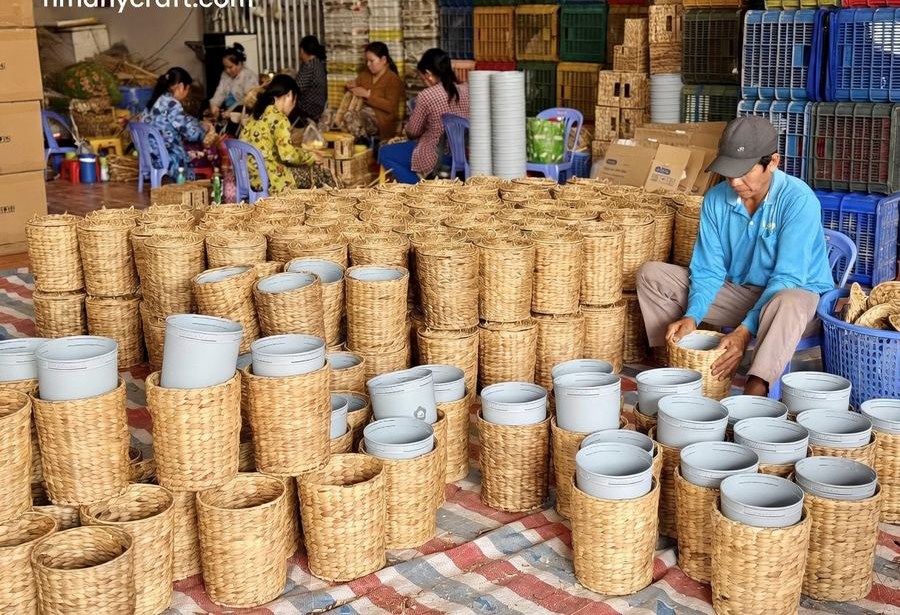
Water hyacinth is a Mekong Delta story. The plant grows year-round in the delta's warm, slow-moving waterways — Đồng Tháp, An Giang, Bến Tre, and Kiên Giang provinces are the historical harvest heartlands. The cottage weaving network sits close to the water source; artisans harvest in the morning, dry the stems near their homes, and weave in the same villages. Consolidation to Ho Chi Minh City for QC, anti-mould treatment, and container loading is a two to four hour truck run.
Seagrass grows in coastal marshland in the north-central coast: Ninh Bình (particularly the Kim Sơn district), Thanh Hóa (Nga Sơn), and parts of Hà Tĩnh. The weaving communities are older than the water hyacinth network — some Nga Sơn weaving villages have documented histories going back several centuries. Consolidation to Ho Chi Minh City is a longer inland freight run, which adds two to three days to the finished-goods logistics but does not change the FOB price meaningfully.
The practical implication for buyers: a mixed water hyacinth and seagrass programme is a two-region production run internally, even though it ships as one container from one port. HMD manages both ends of the country logistics so the buyer sees one PO, one B/L, and one consolidated delivery timeline.
Which one for your programme?
Under $10 FOB per unit, volume-driven retail. Water hyacinth almost always wins on unit economics.
Table décor, trays, structured smaller pieces. Seagrass gives the cleaner finish.
Full natural-fibre retail range. Mix them. Water hyacinth for the volume categories, seagrass for the accent categories.
Not sure yet? Order a two-fibre sample pack against the same design brief. Watching your merchandising team react to real samples resolves 90 percent of the material choice in about ten minutes.
Container maths side by side
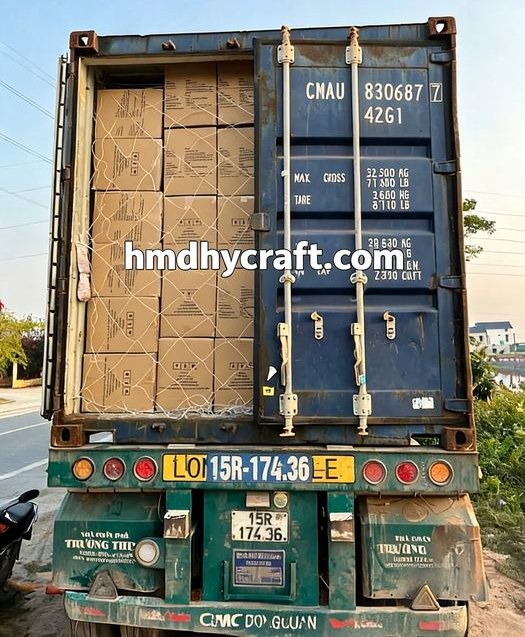
A 40' high-cube container of nested water hyacinth storage baskets typically carries 2,200 to 3,000 pieces from Ho Chi Minh City. The same container of nested seagrass baskets typically carries 1,800 to 2,600 pieces. The gap is not about the fibre weight (both are light); it is about weave density. Seagrass baskets are woven tighter and stack less efficiently because the walls flex less under load.
For a mixed programme (roughly 75/25 water hyacinth to seagrass), expect a 40'HQ to land in the 2,000 to 2,700 range. HMD provides the exact container load plan with cartons per SKU, palletisation option, gross weight, and pre-shipment photos before B/L is released.
Choose the fibre that fits the product. Do not force the product onto the fibre.
For any given retail SKU, one of the two fibres will be materially better than the other. The mistake is picking a fibre first and forcing the design onto it. Send the design brief; the material choice follows.
Frequently asked questions
Is water hyacinth stronger than seagrass?
Neither is universally stronger. Water hyacinth has the edge in large storage and laundry pieces because the thicker fibre holds shape under load. Seagrass has the edge in small structured pieces and flat trays because the tighter weave stays dimensionally accurate.
Which is cheaper for wholesale?
Water hyacinth is 15 to 25 percent cheaper per equivalent unit at wholesale FOB Ho Chi Minh City. The gap comes from raw material abundance, weaving hours per piece, and QC reject rates on dyed finishes.
Which fibre is best for laundry baskets?
Water hyacinth is the standard for laundry hampers at wholesale scale. Lightweight, breathes well, and the fuller fibre gives the basket enough body to stand upright when full without an internal frame.
What is the difference between seagrass and grey sedge?
Seagrass (cói) is a fine, rope-like fibre from coastal marshland. Grey sedge is a coarser marsh grass used for mats and rougher weaves. They look similar in photographs and are frequently confused, but they weave and finish differently and are priced differently.
Can I mix water hyacinth and seagrass in one container?
Yes, and most retail programmes do exactly that. HMD consolidates both fibres into a single 40'HQ container with one B/L. A rough pairing ratio is 70 to 80 percent water hyacinth by unit count, 20 to 30 percent seagrass.
Which fibre lasts longer in humid environments?
Both are natural cellulose fibres and both benefit from ventilated storage below 65 percent relative humidity. Water hyacinth has a slight edge if the basket does pick up moisture, because the thicker stem is less prone to warping.