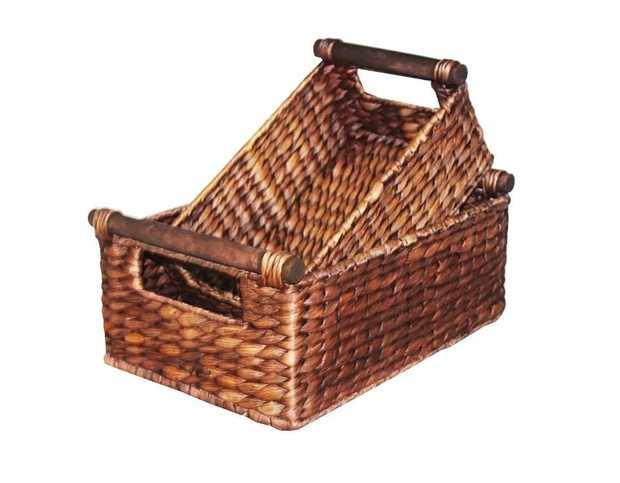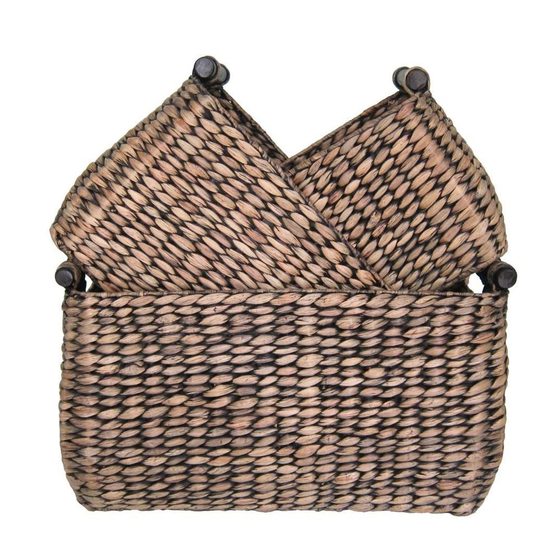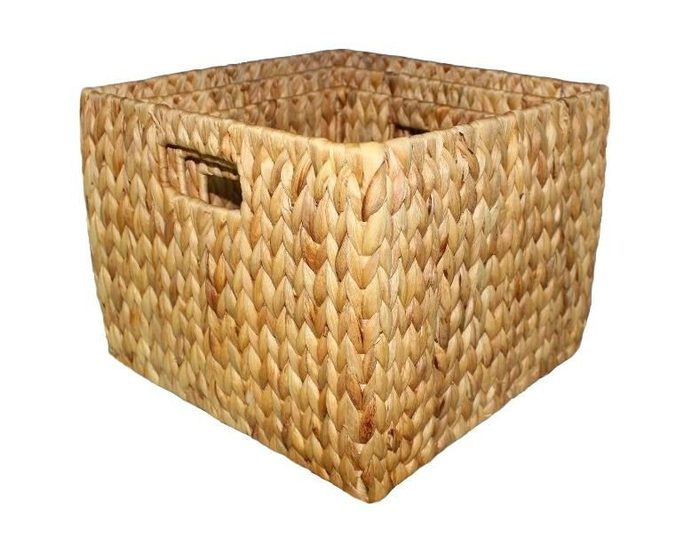
Placeholder hero image. Side-by-side comparison photograph to replace this shot.
Water hyacinth and bamboo look like cousins in a category shot. They behave in opposite ways on the shelf. Water hyacinth is soft, absorbent, and cannot see food. Bamboo is rigid, washable, and lives in kitchens and dining rooms. Getting the fibre wrong here does not just cost a sample round; it can send a food-contact SKU back at import inspection.
Written for wholesale buyers, e-commerce category managers, and private-label programmes deciding between the two most popular natural fibres for retail baskets and kitchen accessories. Covers what each material actually is, the honest food-safety story, the 10 to 30 percent price gap, and how retailers pair them in kitchen and storage ranges.
What each material actually is
Water hyacinth (lục bình in Vietnamese) is a floating aquatic weed harvested from the Mekong Delta. Stems are cut close to the waterline, sun-dried for three to five weeks into long tan cables, then twisted or braided into rope and hand-woven over a frame. The finished fibre is soft, warm-toned, breathes well, absorbs moisture, and cannot be washed. It sits comfortably in dry-storage categories: storage baskets, laundry hampers, gift hampers, cachepot sleeves.
Bamboo is a woody grass, not a wood and not a fibre in the same sense as water hyacinth. Vietnam produces three main commercial species (Bambusa, Dendrocalamus, and Phyllostachys), harvested on a rolling five to seven year cycle from managed groves. The culm (the hollow stalk) is cut, split, heat-treated against beetles, and either used whole (as poles) or split into flat strips that get woven, glued, or laminated into finished pieces. Bamboo is rigid, dense, food-safe when finished correctly, and washable in ways water hyacinth is not.
Two very different production systems. Water hyacinth is a soft-weave cottage craft. Bamboo is closer to woodworking than to weaving, with the fibre often laminated or joined rather than woven at all.
The comparison at a glance
| Attribute | Water hyacinth (lục bình) | Bamboo (tre) |
|---|---|---|
| Source | Aquatic weed, Mekong Delta | Woody grass, managed groves nationwide |
| Fibre character | Soft, absorbent, warm to touch | Hard, dense, cool to touch |
| Construction | Woven over frame | Split strips woven, glued panels, or whole culms joined |
| Natural colour | Warm tan, honey brown | Pale beige to dark carbonised (heat-treated) |
| Food-contact safe | No (absorbs oil and moisture) | Yes (with correct finish and oil treatment) |
| Washable | Spot clean only, never submerge | Hand wash with mild soap, air-dry thoroughly |
| Holds shape best in | Storage, laundry, hampers, floor pieces | Bread baskets, steamer trays, kitchen storage, frames |
| Typical FOB price per unit | Baseline | +10 to +30 percent |
| Standard lead time | 45 to 60 days | 55 to 75 days |
| Container fit (40'HQ) | 2,200 to 3,000 pieces nested | 1,600 to 2,400 pieces |
Where water hyacinth wins
Water hyacinth wins the categories where the piece has to be soft in the hand, warm-toned on the shelf, breathable in use, and affordable per unit. Those categories together cover most of the utility natural-fibre market outside the kitchen.
- Volume storage programmes. Nested storage baskets, set-of-2 and set-of-3, ship 2,200 to 3,000 pieces per 40'HQ. Bamboo storage baskets exist but at a higher price and lower container fit.
- Laundry hampers. Fuller fibre stands upright when full, breathes so damp cotton does not stagnate, and stays lightweight when the hamper gets lifted. Bamboo laundry hampers exist but are heavier and less forgiving on skin contact.
- Gift hampers and seasonal SKUs. Water hyacinth takes brown wash, black wash, and white finish cleanly. The warm tone reads holiday and gifting more naturally than bamboo's cool tone.
- Cachepot sleeves and planter baskets. Water hyacinth tolerates incidental indoor humidity better than bamboo's finished surface, which can develop hairline cracking under long-term wet-pot contact.
- Nursery and children's soft storage. No hard edges, no splinters, softer visual language.
Water hyacinth is out of the running the moment food safety enters the brief. The fibre is porous, absorbs oils, cannot be hygienically cleaned, and is not certified for direct food contact by any major import regulator. For food-adjacent SKUs (bread hampers, gift hampers containing food) water hyacinth works with a food-grade cotton liner in place — never in direct contact.
Where bamboo wins
Bamboo wins any category where the piece has to interact with food, resist repeated cleaning, hold precise dimensions, or carry structural load. In wholesale terms, that anchors bamboo to the kitchen and dining categories in a way water hyacinth cannot compete with.
- Food-service baskets. Bread baskets, sandwich baskets, dim sum steamer trays, food-truck presentation trays. Bamboo is the correct fibre when food touches the basket directly. Water hyacinth is not.
- Kitchen storage. Utensil holders, produce baskets, tea storage boxes, fruit trays. Bamboo can be cleaned with mild soap and water; water hyacinth cannot.
- Rigid frames and box construction. Bento boxes, tea caddies, jewellery boxes, cutlery organisers. Bamboo panels hold precise dimensions and take joinery in ways woven fibres cannot.
- Furniture accents. Bamboo poles form chair frames, table bases, screens, room dividers, and pendant light shades. Structural without the price premium of rattan.
- Outdoor-adjacent SKUs. Bamboo tolerates outdoor use better than either water hyacinth or seagrass when properly oiled and stored under cover. It is not fully outdoor-rated in its natural form but survives sheltered patios and covered porches better than the softer fibres.
Bamboo is not the right fibre for soft-touch storage or gift hampers. The rigidity and cooler tone read as functional rather than warm, and the weight per unit runs higher than the equivalent water hyacinth basket for retail volume programmes.
The honest food-safety story
This is the section most buyers care most about and most sales decks skip. Here is the honest version.
Water hyacinth is not food-contact safe in its untreated form. The porous fibre absorbs oil and moisture from any food it touches, cannot be hygienically cleaned, and traps bacteria in the fibre voids. HMD does not certify water hyacinth for direct food contact and does not recommend it for food-service SKUs. For food-adjacent use (a gift basket that contains food packaged separately, a bread hamper with a cotton liner) water hyacinth is fine as a decorative container as long as the food itself is not touching the fibre.
Bamboo is food-contact safe when finished correctly. Split bamboo and whole bamboo culms accept food-grade mineral oil, beeswax finish, or lacquer-based finishes that meet FDA and EU food-contact regulations. Bamboo steamer trays, bread baskets, and sandwich presentation pieces are made from bamboo for exactly this reason. HMD supplies bamboo food-service SKUs with food-grade finish certification when the buyer's programme requires it.
Washing rules differ. Bamboo baskets used for food service should be hand-washed with mild soap, air-dried thoroughly, and treated with food-grade mineral oil every one to three months to prevent the fibre from drying and cracking. Water hyacinth baskets should not be washed at all — spot-clean only with a lightly damp cloth, and let air-dry in shade.
If the retail programme mixes food-service and soft storage, the fibre choice per SKU is made for you: bamboo where food touches, water hyacinth where nothing hot or wet touches.
Price and lead time
Bamboo runs 10 to 30 percent more expensive per equivalent unit than water hyacinth at wholesale FOB Ho Chi Minh City. The gap is smaller than the rattan gap because bamboo raw material is abundant and cheaper than rattan poles, but it is larger than the seagrass gap because bamboo pre-processing is more labour-intensive per finished piece.
Three cost drivers. First, culm preparation: harvested bamboo needs cleaning, node removal, splitting, and heat treatment against powder-post beetles before it can be woven, glued, or joined. Second, joinery labour: bamboo pieces that hold precise dimensions require carpentry-adjacent skills the softer fibres do not need. Third, finishing certification: food-grade finish on bamboo food-service SKUs adds cost that soft-storage water hyacinth pieces avoid entirely.
Lead time gap is 10 to 15 days. Water hyacinth runs 45 to 60 days; bamboo runs 55 to 75 days. Peak-season windows (August to November) push both fibres out by another 10 to 15 days. Bamboo capacity tends to book earlier because the specialised joinery skill pool is smaller.
How retailers actually pair them
Retailers with kitchen, dining, and soft-storage categories in the same catalogue naturally pair water hyacinth and bamboo. The material choice is not a preference; it is dictated by whether food touches the piece.
- Bamboo for kitchen and dining: bread baskets, produce baskets, utensil holders, steamer trays, food-service presentation, tea and coffee storage, cutting-adjacent SKUs.
- Water hyacinth for soft storage and gifting: storage bins, laundry hampers, gift hampers with liners, closet organisers, nursery bins, cachepot sleeves, magazine holders.
The two lanes rarely overlap. Where they do overlap (mid-scale hampers, decorative kitchen storage that does not touch food), the decision usually comes down to whether the retail brand voice reads warmer or cleaner. Warmer brands (rustic, farmhouse, cottage) lean water hyacinth. Cleaner brands (minimalist, contemporary, Japanese-influenced) lean bamboo.
HMD consolidates both fibres into a single 40'HQ container on one B/L. A typical mixed container from a retailer stocking both categories runs 60 to 75 percent water hyacinth by unit count, 25 to 40 percent bamboo, with the bamboo side heavily weighted toward the kitchen and dining SKUs.
Which one for your programme?
Food touches the basket. Bamboo. There is no other answer. Water hyacinth is not food-safe.
Volume soft storage under $10 FOB. Water hyacinth wins on unit and container economics.
Kitchen and dining category catalogue. Both. Bamboo for food-service, water hyacinth for adjacent gift and storage SKUs.
Not sure yet? Send the SKU list. HMD will annotate which fibre fits each SKU by function, not by preference.
Container maths side by side
A 40' high-cube container of nested water hyacinth storage baskets typically carries 2,200 to 3,000 pieces from Ho Chi Minh City. The same container of bamboo pieces at comparable dimensions typically carries 1,600 to 2,400 pieces. Bamboo pieces are heavier per unit than water hyacinth and nest less tightly because rigid components (frames, joined panels) do not compress into each other the way soft weave does.
On a mixed programme (roughly 70 percent water hyacinth to 30 percent bamboo by unit count), a 40'HQ typically lands in the 1,900 to 2,700 piece range. The container weight starts to matter more with bamboo in the mix; HMD provides gross weight and axle-load estimates in the container load plan so the buyer's forwarder can pre-book the correct chassis at DC receiving.
Water hyacinth for what stays soft. Bamboo for what needs to touch food or hold shape under joinery.
Two natural materials, two very different production trees, one shared shelf category ("natural home décor and kitchen") that hides the operational gap. Get the fibre right per SKU and both work brilliantly in the same catalogue.
Frequently asked questions
Is bamboo food-safe? Is water hyacinth food-safe?
Bamboo is the food-service fibre of choice when finished with food-grade oil or lacquer. Water hyacinth is not food-contact rated; use a cotton liner if food packaging must sit inside a water hyacinth basket.
Is bamboo cheaper than water hyacinth?
No. Bamboo is 10 to 30 percent more expensive per equivalent unit at wholesale FOB Ho Chi Minh City. Culm preparation and joinery labour add cost that soft-weave water hyacinth avoids.
Which is stronger — water hyacinth or bamboo?
Bamboo is structurally stronger and carries compression and tension water hyacinth cannot. Water hyacinth is softer in the hand and lighter to carry.
Are bamboo baskets dishwasher safe?
No. Hand-wash bamboo baskets with mild soap, air-dry thoroughly, and treat with food-grade mineral oil every one to three months. Water hyacinth baskets should not be washed at all — spot-clean only.
Can I mix water hyacinth and bamboo in one container?
Yes. HMD consolidates both fibres into one 40'HQ container on a single B/L. A typical mixed ratio for kitchen-plus-storage catalogues is 60 to 75 percent water hyacinth by unit count, 25 to 40 percent bamboo.
Which fibre is more sustainable?
Both are among the more sustainable natural materials available and both are biodegradable. Water hyacinth has an invasive-species harvest angle; bamboo has a fast-growing five-year replantable harvest cycle. Neither requires pesticide in its Vietnamese production.