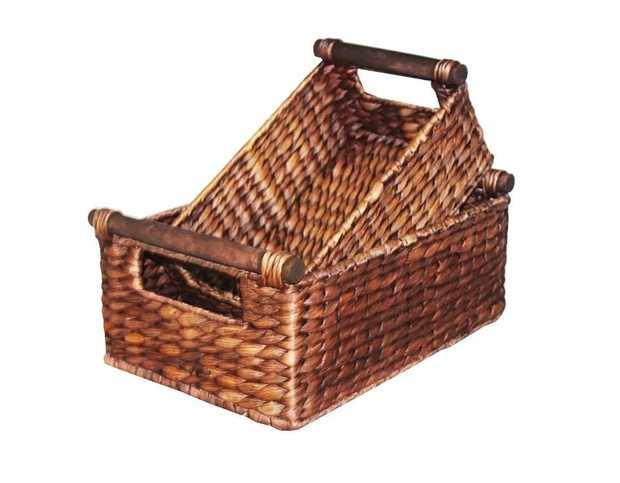
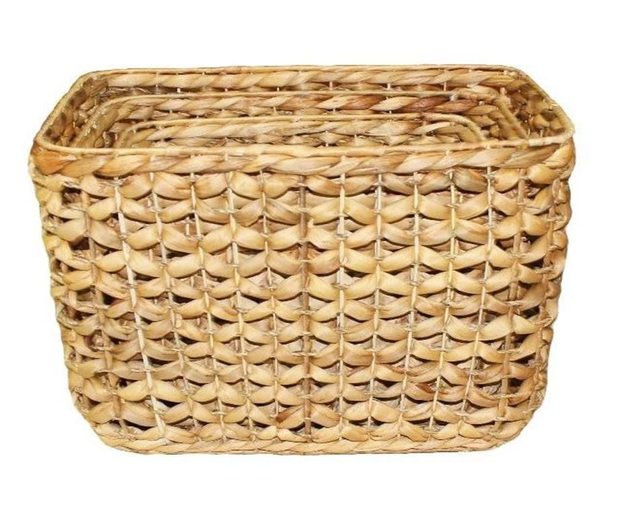
A handwoven basket sells or fails on its product photography before the shopper reads a single word of description. DTC brands, marketplace sellers, and small retailers with in-house creative teams routinely under-invest in this stage and pay for it in lower conversion, worse ad ROAS, and higher returns from mis-set expectations. This brief is the 8-shot photography list HMD delivers for extended-package SKUs, and the reasoning behind each shot.
Written for DTC founders, marketplace sellers, and small retailers who need to fill an Amazon or Shopify PDP without a full-scale studio shoot budget. The 8 shots cover every image slot a modern product listing needs. Applies to water hyacinth, seagrass, bamboo, and rattan basketwork at any scale from single-unit retail through case-pack wholesale.
Why 8 shots and not 3
The default "just give me the hero photo" mindset comes from an older era of e-commerce where PDPs showed one large image and maybe two thumbnails. Modern PDPs — Amazon, Shopify's dawn/spotlight themes, Etsy — support 6 to 10 images per listing, and shopper behaviour data shows conversion increases substantially with each additional image up to about 7 or 8 shots. Beyond 8 the marginal lift flattens.
The 8-shot brief is designed to fill exactly that curve: cover every PDP image slot with a purposeful shot, without producing photos the shopper will not look at.
The 8 shots, in order of PDP placement
Shot 1 — PDP hero (square, neutral background)
Purpose: Primary listing image. Amazon requires white background; Shopify allows soft neutral (cream, warm grey). Basket photographed at slight downward angle (about 15 degrees from horizontal) to show top opening and depth. Basket empty, no props, centred in frame with 10-15% edge padding. Square 3000x3000 minimum resolution.
Why it matters: This is the image on the search results page. If it does not read cleanly at thumbnail size (200-300 pixels wide), the shopper never clicks. Test the shot at thumbnail size before approving.
Shot 2 — Straight-on side view (square, neutral background)
Purpose: Second PDP thumbnail. Shows the basket profile at true dimensions — the shopper's mental sizing question ("how tall is this really?") gets answered here. Photographed at exact eye level (no downward angle), basket empty, same neutral background as Shot 1.
Why it matters: Height/width proportions confuse shoppers when the hero shot's downward angle distorts the profile. The straight-on side view is the truth-teller.
Shot 3 — Close-up weave detail (portrait, extreme close)
Purpose: Shows fibre character, weave density, colour tone at intimate range. Photographed with macro capability — the individual fibres should be visible with texture. Portrait format so the weave detail fills the frame vertically.
Why it matters: Natural fibre is bought partly for its material story. This shot separates handwoven from machine-woven visually and reassures shoppers about quality.
Shot 4 — Top-down flat lay (square, showing interior)
Purpose: Bird's-eye view directly into the basket interior. Shows base weave, internal capacity, any liner detail. Basket empty; shot from directly overhead with even lighting to avoid deep shadows inside the basket.
Why it matters: Shoppers use this shot to imagine what they will store inside. Blocked-out shadows or unclear base weaving lose sales.
Shot 5 — Scale reference (portrait, in-hand or beside human)
Purpose: Contextual sizing shot. Basket held by a model (hand only, no full-body model needed) or placed beside a common reference object (chair, coffee table, opened book). Shopper's mental question "how big is this really?" gets answered.
Why it matters: Reduces "smaller than expected" returns significantly. Amazon's own data suggests scale-reference shots on home décor listings reduce returns by 15-25%.
Shot 6 — Lifestyle room set (landscape, styled)
Purpose: Aspirational context. Basket photographed in a believable room setting — bathroom shelf, bedroom corner, living room side table, entryway. Styled with 2-3 small props (folded towel, houseplant, ceramic bowl) that suggest use case without dominating the frame.
Why it matters: Shopper visualises the product in their own home. This is the shot most likely to trigger the emotional buy.
Shot 7 — Set composition (if applicable, square)
Purpose: For set-of-2 or set-of-3 SKUs, shows all pieces arranged together — typically nested with the smaller pieces displaced beside the larger. Shopper sees the range clearly instead of assuming only one basket ships.
Why it matters: Set-of-2 and set-of-3 SKUs where the hero shot only shows one basket often get returned or 1-star-reviewed by shoppers who expected all pieces to be individually pictured.
Shot 8 — Detail of finishing touch (portrait, close)
Purpose: Close-up of a distinctive finishing element — the wooden handle grain, the leather patch, the ribbon tie, the printed hangtag, the cotton liner stitching. Shows craftsmanship at the level shoppers do not see in the hero shot.
Why it matters: Justifies the price band. Distinguishes handwoven from machine-woven at a level below the shopper's usual attention. This is the shot that converts price-sensitive shoppers into premium buyers.
Optional shots for premium programmes
- 360-degree turnaround. Series of 24-36 shots rotating around the basket at 10-15 degree intervals, delivered as a single interactive file for Shopify's AR viewer or Amazon's 360 rotation feature. Adds 2 weeks to lead time.
- Short-form product video (15-30 seconds). Basket rotating on turntable + macro weave detail + handle detail + lifestyle context, cut to 15-30 seconds for social ad use. Adds 3-4 weeks lead time. Video content lifts conversion 8-15% on typical DTC listings.
- Contextual-scale video (10-15 seconds). Model handling the basket, opening lid, placing objects inside. Communicates weight and stiffness in a way still images cannot.
- Colour-swap gallery. If SKU is available in multiple colourways, all colour options photographed in identical hero shot format so shopper can compare instantly. Standard for private-label programmes with 3+ colourway options.
Photography spec details HMD applies by default
| Element | Spec |
|---|---|
| Resolution | 3000×3000 minimum (square), 3000×4000 (portrait) |
| Format | High-quality JPG at 85-92 quality setting, sRGB profile |
| Colour temperature | 5500K daylight balanced |
| Background (neutral shots) | Cream #F6F4ED for lifestyle, pure white #FFFFFF for Amazon requirement |
| Lighting | Softbox key + fill + background separation light |
| Basket state | Freshly unpacked, weave brushed, no dust, no shipping compression marks |
| Colour accuracy | ColorChecker card in reference frame; delivered images match physical basket colour within 3 delta-E |
| Delivery format | WeTransfer download link, folder per SKU, filenames including SKU code |
What the buyer supplies to make the shoot work
- SKU codes + product names per shot list — used for file naming and delivery folder structure.
- Aesthetic direction reference for lifestyle shots — Pinterest board, mood board PDF, or 3-5 reference images from your existing brand photography.
- Prop notes — colours to include, colours to avoid, any hero prop (a specific throw, a branded ceramic) that MUST appear.
- Model/hand preference for scale shot — skin tone, no jewellery vs jewellery welcome, right hand vs left hand.
- Buyer's brand guidelines — hangtag artwork if branded, packaging shots to include or exclude, logo placement rules.
The single most common photography mistake DTC brands make
Approving photography without checking it at thumbnail size first. Amazon search results, Shopify collection pages, Google Shopping feeds — all display images at 200-400 pixels wide. A hero shot that looks beautiful at 3000 pixels can read as an indistinct beige blob at 300 pixels. Before approving any 8-shot brief, view every shot at exactly the resolution it will display on your primary sales channel. Any shot that does not read clearly at thumbnail size needs to be re-shot with tighter framing.
Photography lead time built into the production cycle
HMD schedules photography to coincide with pre-shipment QC — the sample pieces used for the shoot are pulled from the actual production batch, photographed at HCMC studio during the QC window, then returned to the container for shipping. Timeline:
- 1.Baseline 2-shot package: No lead-time addition. Ships same week as container.
- 2.8-shot extended brief: +2 to 3 weeks after production complete. Photo delivery ~1 week after container FOB date.
- 3.Video package: +3 to 4 weeks. Delivered 1-2 weeks after photo delivery.
- 4.360-degree turnaround: +2 weeks. Delivered with 8-shot brief.
Product photography is the highest-leverage $2,000 an e-commerce brand spends on a new SKU.
DTC brands routinely spend $500 per SKU on Amazon PPC without hesitation, then push back on paying $200 per SKU for extended photography. The math is backwards. Photography scales infinitely across every ad, every listing view, every social post. PPC spend is a per-click cost with no compounding value. Get the photography right first; PPC follows.
Frequently asked questions
Does HMD provide product photography with every SKU?
Yes. Baseline 2 photos (neutral background + lifestyle) with every SKU at no additional cost. 8-shot extended brief quoted per SKU with 2-3 weeks lead time addition.
What resolution do the photos ship at?
3000x3000 (square) or 3000x4000 (portrait) minimum. 300 DPI, JPG 85-92 quality, sRGB. Print-ready TIFF on request.
Can I supply my own props for the lifestyle shots?
Yes but adds shipping cost + 2-3 weeks lead time. Most buyers specify aesthetic direction and HMD sources props locally in HCMC.
How is the styled lifestyle shot set up?
Single basket in neutral room context, natural window light, minimal styling props. Believable-home aesthetic rather than magazine aspirational. Buyer can specify aesthetic direction at PO.
What is the turnaround for extended photography packages?
2-shot baseline same week as container. 8-shot brief +2-3 weeks. Video +3-4 weeks. 360-degree +2 weeks.
Who owns the photography HMD produces?
Standard catalogue SKU photos: HMD retains ownership, buyer gets perpetual non-exclusive licence. Buyer's private-label spec photos: buyer receives exclusive ownership with small extended-package fee.