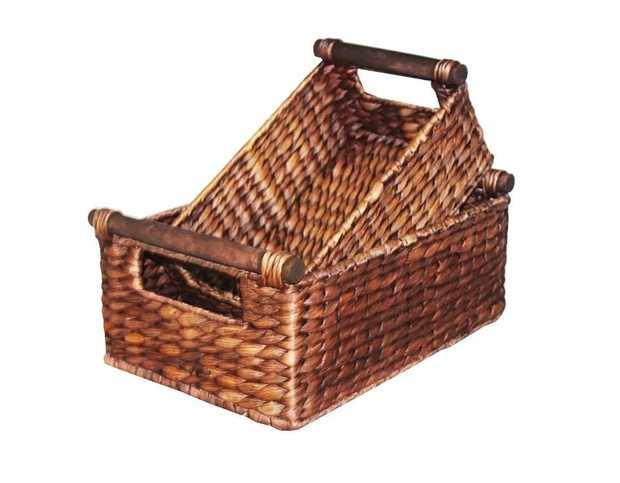
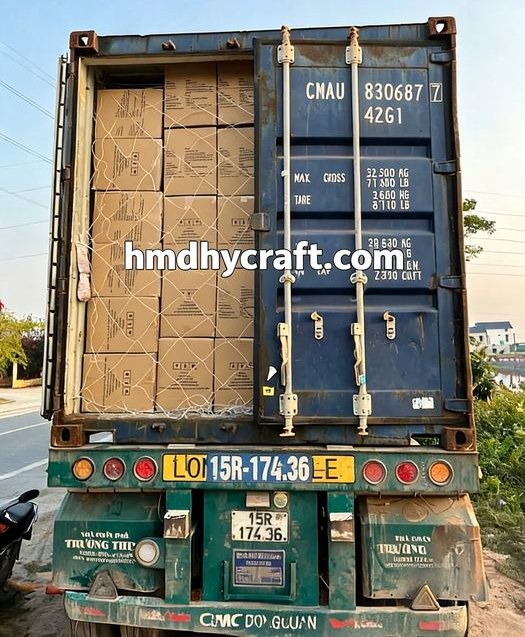
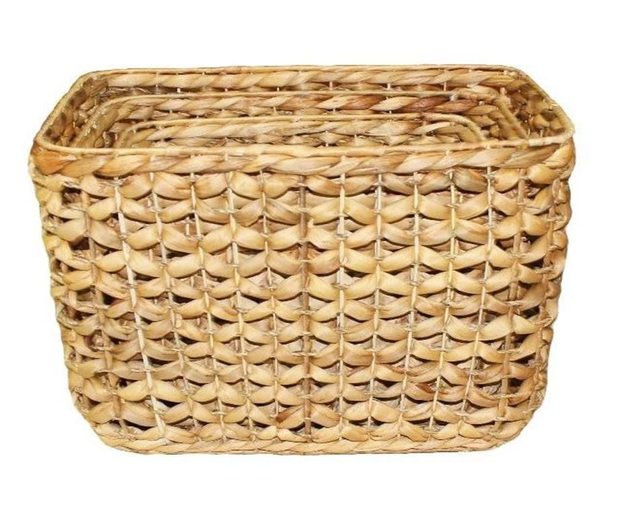
Three composite case studies of Amazon FBA private-label brands sourcing handwoven baskets from Vietnam through HMD. Every specific quantity, price band, and timeline is drawn from real launches over 2024 to 2026 — details are anonymized and lightly composited to avoid identifying any single brand. The point is the shape of what worked, what did not, and why.
Written for DTC founders considering an FBA-first private-label launch in the natural-fibre home décor category, and for existing FBA sellers planning a Vietnam sourcing shift from Chinese suppliers. The mechanics apply to water hyacinth, seagrass, bamboo, and rattan basketwork under HS 4602.
Small DTC brand, San Diego — 5 SKUs, $28-$45 retail band
Programme shape. Founder-owned brand launched Q3 2024 with 5 SKUs across storage baskets, laundry hampers, and gift trays. First PO: 300 pieces each SKU (1,500 total), mixed 40HQ from HCMC to Los Angeles port, forwarded to FBA warehouse in Ontario, CA. Total first-order value at FOB: $9,240. Landed cost per unit ranged $8.20 to $14.60 after ocean freight, customs, and Amazon inbound fees.
Timeline. PO confirmed February; production Feb-April; container FOB HCMC end of April; ocean transit 16 days; FBA live May 20. First sale on Day 1 of listing (PPC-driven). Reviews accumulated to 12 by Day 30, 34 by Day 90. All 5 SKUs hit stable-state velocity by Day 100.
Sell-through result. First shipment (1,500 pieces) sold through in 145 days at retail price band $28-$45. Blended ROAS 2.8x through PPC, organic contribution ~35% by month 4. Founder placed second PO in month 3 to keep FBA stock live; second PO expanded to 7 SKUs at the same 300 MOQ per SKU. By end of year 1, brand had shipped 4 containers, 8 SKUs live, roughly $84,000 gross revenue in the FBA channel.
What worked. Small tight assortment. Every SKU got real PPC attention and enough sell-through data to make repeat vs drop decisions. Vine review generation on first 3 SKUs at $200/ASIN paid back within 45 days.
What did not. One SKU (a decorative floor planter) never hit velocity because carton weight exceeded Amazon's standard tier and inbound fees ate margin. Dropped on second PO.
Mid-scale marketplace seller, Toronto — 12 SKUs, $32-$58 retail band
Programme shape. Existing Amazon seller (established in kitchenware category) expanded into handwoven baskets Q4 2024. Ordered 12 SKUs at 300 MOQ each on first PO (3,600 total pieces), full 40HQ from HCMC to Long Beach, forwarded to FBA warehouses in Southern California and Pennsylvania. Total first-order FOB: $22,400. Landed cost per unit $9.80 to $18.20.
Timeline. PO confirmed October; production Oct-Dec; container FOB HCMC mid-December (Christmas peak-season backlog); ocean transit 22 days; FBA live end of January. Reviews accumulated slowly because PPC budget spread across 12 SKUs meant no single SKU got enough traffic to trigger organic ranking in months 1-3.
Sell-through result. Mixed. 4 of 12 SKUs hit stable velocity by month 4 and drove roughly 80% of gross revenue. Remaining 8 SKUs turned inventory 2.5 to 4 months slower than plan; some pieces sat in FBA warehouse for 9+ months triggering long-term storage fees. First-year gross revenue $105,000 but with $18,000+ in avoidable Amazon fees.
What worked. Category expansion validated. Buyer identified 4 winner SKUs to double down on in year 2.
What did not. Spreading 300 MOQ × 12 SKUs on first bet was too much. Should have launched 6 SKUs, sold through, then expanded. Also: floor planter SKU (again) failed carton-weight tolerance and had to be re-boxed at FBA warehouse ($1,800 unplanned cost). One SKU had a private-label hangtag misprint (buyer artwork error, not HMD's) requiring a $600 hangtag-swap service at FBA warehouse.
Gift-hamper e-commerce brand, London — 8 SKUs, seasonal + evergreen mix
Programme shape. UK-based gift hamper brand launched a "basket-only" FBA sub-line Q2 2025 to complement their existing hamper business (which fills baskets with food/wine and ships direct via Royal Mail). FBA line ordered 8 SKUs at 300 MOQ each (2,400 total), mixed 40HQ from HCMC to Felixstowe, DCTS zero-duty entry, forwarded to Amazon UK Coventry FBA. Total first FOB: $14,800. Landed cost per unit $10.40 to $16.80.
Timeline. PO confirmed March; production March-May; container FOB HCMC mid-May; ocean transit 38 days; FBA live end of June. Prime Day (July 15-16) generated ~4x normal daily volume across 3 hero SKUs. Christmas peak (November-December) generated ~6x normal daily volume across all 8 SKUs.
Sell-through result. 78% sell-through of first shipment by end of December. Remaining 22% (mostly slower-moving accent SKUs) cleared by mid-February. Second PO placed in September to ensure stock for Christmas peak — expanded to 10 SKUs (added 2 seasonal SKUs specifically for the gift-hamper aesthetic). Year 1 gross revenue in FBA channel: £68,000, with 62% of it earned in November-December window.
What worked. Aligned FBA launch with existing brand's seasonal cadence. Cross-promoted the FBA basket line to the hamper business's email list (~28,000 subscribers), driving early PPC-less sales that unlocked organic ranking fast.
What did not. Two SKUs at the low end of the price range ($18-$22) cannibalised the more profitable mid-range SKUs during Christmas peak. Dropped on the year-2 planning cycle.
Patterns across all three cases
| Dimension | Case A (5 SKU) | Case B (12 SKU) | Case C (8 SKU) |
|---|---|---|---|
| First PO value (FOB) | $9,240 | $22,400 | $14,800 |
| Total pieces | 1,500 | 3,600 | 2,400 |
| Retail price band | $28-$45 | $32-$58 | £16-£38 (~$20-$48) |
| First-shipment sell-through | 100% in 145 days | ~55% in 145 days | 78% by end of Dec |
| SKUs surviving to year 2 | 4 of 5 (80%) | 4 of 12 (33%) | 6 of 8 (75%) |
| Year 1 gross revenue | ~$84,000 | ~$105,000 | ~£68,000 (~$86,000) |
| Long-term FBA storage fees | Minimal | $18,000+ | Minimal |
Case A and Case C outperformed Case B on almost every metric that matters — inventory turn, SKU survival, PPC efficiency, avoided fees. The difference was assortment discipline. Case A launched 5, Case C launched 8. Case B launched 12 and paid for it in long-term storage fees, slow-moving inventory, and PPC dilution across too many ASINs.
The FBA-specific workflow with HMD
What FBA sellers need from a Vietnamese supplier is slightly different from what a traditional wholesale buyer needs. Four workflow-specific items:
- FNSKU barcode printed on retail unit. Buyer generates FNSKU in Amazon Seller Central for each ASIN, exports as PDF, shares with HMD at PO stage. HMD prints FNSKU on retail hangtag or stick-on label at packing. No unit-price change, no lead-time change.
- Polybag with suffocation warning where the ASIN category requires it. Basket storage SKUs typically do not need polybag; some smaller decorative pieces do. HMD reviews the ASIN category and applies polybag where Amazon requires. Polybag adds negligible cost per unit ($0.02 to $0.05).
- Master carton labelled with FBA shipment ID. Buyer creates the FBA shipment in Seller Central, assigns to a specific FBA warehouse, exports the shipment ID label as PDF, shares with HMD. HMD applies the shipment ID label to the outside of each master carton before container loading.
- Carton dimensions inside Amazon FBA tolerance. Standard tier: master carton ≤50 lbs, ≤25 inches on longest side, ≤63 inches L+2(W+H). Oversized SKUs (tall laundry hampers, floor planters) may exceed and trigger unplanned service fees. HMD reviews SKU dimensions at PO stage and flags any that fall outside standard tier.
Review generation — the make-or-break of an FBA launch
Handwoven basket ASINs need 15 to 25 reviews before Amazon's algorithm ranks them competitively for category search. Without reviews, PPC is the only traffic source, and PPC-only ASINs rarely earn positive contribution margin on units under $30 retail.
Vine (Amazon's own review program) is the fastest reliable path. Vine costs $200 per ASIN and delivers up to 30 free-product reviews from vetted Amazon reviewers over 45 to 60 days. All three case-study brands used Vine on the first 3 to 5 SKUs at launch. Case A recovered the $600 Vine cost within 45 days on the first SKU alone through the ranking lift.
Beyond Vine: PPC-driven early sales combined with follow-up review-request emails through Amazon's Request Review button. Case C additionally leveraged its existing gift-hamper email list to drive off-Amazon traffic to the FBA listing, which unlocked organic ranking faster than pure PPC + Vine would.
What not to do: fake reviews, incentivised reviews, or paid reviews through third-party services. All are strictly against Amazon terms. ASINs get suspended, seller accounts get suspended, and appeals rarely succeed.
The one FBA-specific mistake to avoid
Ordering an oversized SKU (tall laundry hamper, floor planter, magazine basket) without confirming Amazon FBA carton tolerance in advance. Both Case A and Case B hit this — Case A dropped the SKU on second PO, Case B paid $1,800 in Amazon warehouse re-boxing fees. HMD flags oversized-tier SKUs at PO stage; the fix is either a smaller SKU variant, or shipping direct-to-buyer 3PL instead of FBA for that specific ASIN.
Launch 5. Prove the sell-through. Then expand to 12.
The single biggest lesson across three cases: assortment discipline compounds. A focused 5-SKU launch generates the sell-through data that guides the second PO. A sprawling 12-SKU first launch generates $18,000 in Amazon fees and forces the buyer to make expansion decisions on 8 SKUs that never had a fair test.
Frequently asked questions
How many SKUs should an FBA brand launch with?
5 to 7 SKUs at 300 pieces MOQ each. Fewer means insufficient assortment signal for Amazon's algorithm; more ties up cash faster than sell-through data comes back.
What is the FNSKU workflow with HMD?
Buyer generates FNSKU in Seller Central per ASIN, shares PDF with HMD at PO. HMD prints on retail hangtag or stick-on label. Master cartons labelled with FBA shipment ID. No unit-price change.
What retail price band works for handwoven basket FBA?
$22 to $65. Below $22 fees eat margin; above $65 impulse-buy behaviour drops off.
How long before FBA sales stabilise on a new SKU?
90 to 120 days. PPC drives first 90 days; organic contribution rises through months 4-6 as reviews accumulate.
What is the biggest FBA-specific risk on Vietnamese basket sourcing?
Amazon's carton-dimension and weight tolerance. Oversized SKUs (tall hampers, floor planters) trigger unplanned service fees. HMD flags at PO stage.
How do FBA brands generate reviews for handwoven basket ASINs?
Vine (first 30 reviews at $200/ASIN) is fastest reliable path. PPC + Amazon Request Review button afterward. Never fake or incentivised reviews.