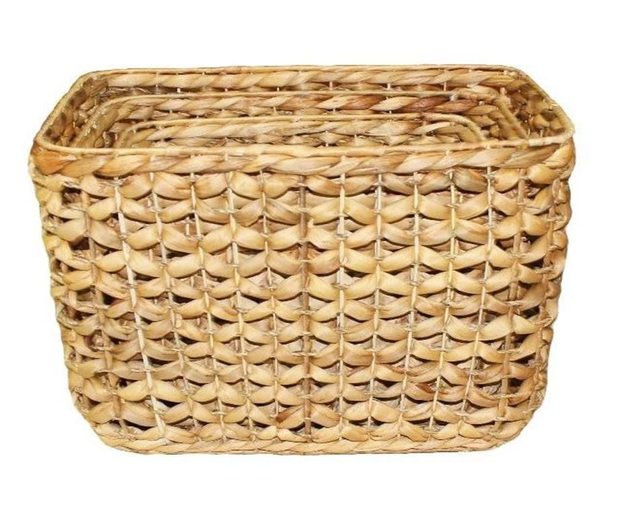
"Yes, we do OEM and private label" is on every basket supplier's website. Most of them mean the same thing when they say it, which is: we will put your label on our design. If that is what you want, fine. If you thought OEM meant something more, this piece is for you.
This is written for retail buyers, e-commerce category managers, and product developers deciding how much control they need over their handwoven basket program. Three sourcing modes, three very different buyer positions.
The three modes, defined properly
| Attribute | Wholesale | Private label | OEM |
|---|---|---|---|
| Whose design | Supplier's | Supplier's, buyer adds brand | Buyer's |
| Whose brand on product | None or supplier | Buyer's brand | Buyer's brand |
| Design exclusivity | None — anyone can buy the same | None — same design sold to others under other brands | Yes, if agreed in writing |
| Typical MOQ per SKU | 50 to 200 units | 200 to 500 units | 500 to 1,000 units |
| Sampling | Existing sample sent | 1 round to confirm branding fit | 2 to 3 rounds against tech-pack |
| Lead time (equal quantity) | Shortest | +2 to 3 weeks vs wholesale | +4 to 6 weeks vs wholesale |
| Unit price | Lowest | +5 to 15 percent vs wholesale | +15 to 30 percent vs wholesale |
| Buyer risk if program fails | Low — resell the stock | Medium — branded stock, harder to redirect | High — custom stock, no secondary market |
Wholesale — supplier's stock, no branding
You buy the supplier's existing design at their existing spec, at a price band published to any qualifying buyer. No custom hangtag, no custom carton, no exclusivity. You resell the product under your own name if you want; the same design is available to your competitors.
Wholesale is right for:
- Small independent retailers testing a category.
- Buyers who need small quantities of many SKUs to fill an assortment.
- E-commerce sellers who compete on curation rather than product differentiation.
- Test orders before committing to private label or OEM.
Wholesale is wrong for:
- Buyers whose retail chain requires branded goods.
- Programs where design exclusivity is part of the retail proposition.
- Anyone whose customer base overlaps with competitors sourcing from the same supplier.
Private label — supplier's design, your brand
You take the supplier's existing design and add your branding: hangtag, care label, retail packaging, and sometimes small colourway adjustments. The design still belongs to the supplier, which means they will (and do) sell the same design to other buyers under other brands. You are not paying for exclusivity.
Private label is right for:
- Mid-tier retail programs that need branded goods but not proprietary design.
- E-commerce brands that compete on brand story, packaging, and merchandising more than on product design itself.
- Buyers testing a category before investing in OEM.
- Anchor SKUs in a range where the differentiation comes from the brand's overall aesthetic, not the individual piece.
Private label is wrong for:
- Flagship product lines where the retail buyer needs to prevent the same design appearing at a direct competitor.
- Programs marketed as "designed by" or "exclusive to" that brand.
- Buyers with brand-protection or IP concerns.
OEM — your design, custom production
You provide the tech-pack, dimensions, weave pattern, colour references, and finishing. The supplier develops a pre-production sample against your spec, and once approved, produces to your design. With a written exclusivity clause, the supplier does not sell the design to any other buyer for the agreed period.
OEM is right for:
- Retail programs where design differentiation is core to the value proposition.
- Buyers with in-house design teams producing tech-packs.
- Flagship SKUs in a range that anchor the brand story.
- Any buyer whose customer would notice if a competitor sold the same design.
OEM is wrong for:
- Programs with small unit volume — the fixed sampling cost is spread over too few units.
- Buyers on very tight timelines. OEM adds 4 to 6 weeks to the calendar minimum.
- Buyers who have not yet validated the category. Do a private label test first, then commit to OEM on the SKUs that sold.
The mixed-mode program most retail buyers actually run
Three or four OEM anchor SKUs at 800 to 1,200 units each for design differentiation and retail-page anchoring.
Six to ten private-label SKUs at 300 to 500 units each to fill out the range at lower cost and shorter lead time.
Wholesale for test-and-learn on a new material or new sub-category before committing to private label or OEM.
This gets you the design story where it matters, the unit economics where it matters, and the flexibility to test without committing every SKU to bespoke development.
The IP conversation before you send your tech-pack
If you are commissioning OEM, get exclusivity in writing before the tech-pack leaves your inbox. What that agreement should cover:
- Exclusivity period. Typically 12 to 24 months from first delivery. Longer for signature pieces; shorter for seasonal.
- Territory scope. Global exclusivity, or exclusivity by region (US-only, EU-only). Global costs more.
- Design ownership. The design IP belongs to the buyer. The supplier retains the right to produce; the buyer retains the right to move production elsewhere.
- Confidentiality. The supplier does not show the design in their catalogue, on their website, on Alibaba, or at trade shows.
- Post-exclusivity treatment. After the exclusivity period, does the supplier retain any rights? Usually no.
Reputable Vietnamese exporters honour these terms. This is easier to enforce in Vietnam than in some other markets because the exporter community is smaller and reputational cost is higher. But get it written down anyway. Verbal exclusivity ends up in someone else's catalogue.
The mode is not what you sell. It is how much of the design decision you own.
If the design decision does not need to be yours, save the money and go private label. If it does, pay the premium and go OEM properly, with the paperwork. What almost never works is claiming OEM in your marketing while actually running private label in your supply chain, because the same product shows up at a competitor within twelve months and the story falls apart.