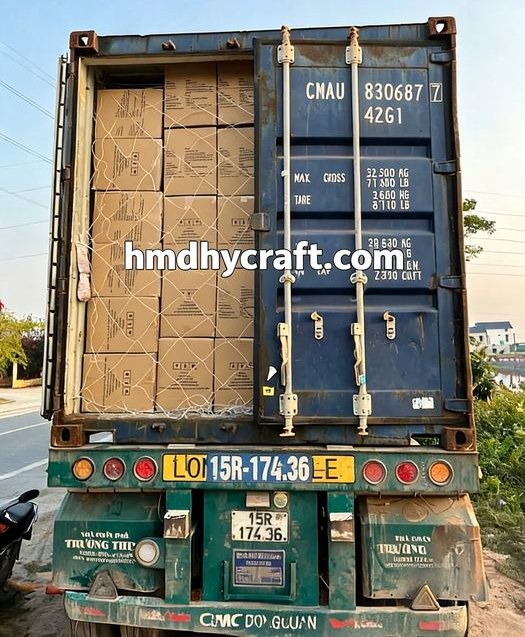
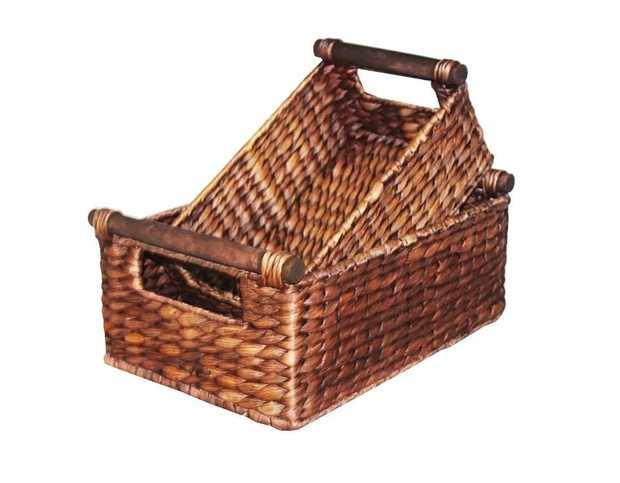
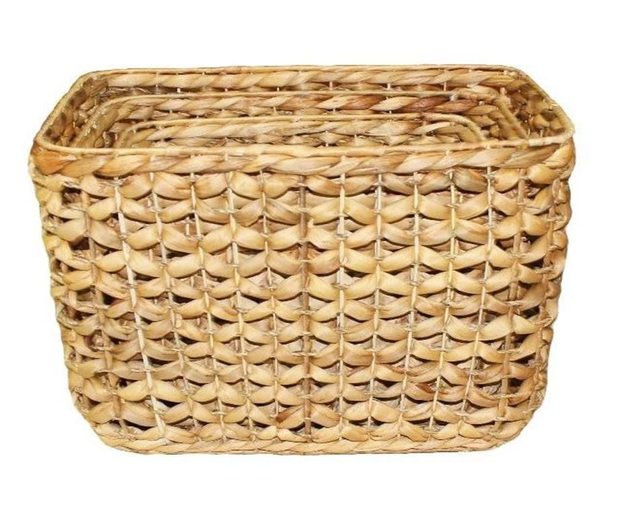
The single most common freight question from a first-time Vietnamese basket buyer: should I book a full container (FCL) or share space with other shippers (LCL)? The right answer varies by volume, destination port, target retail launch date, and how much cosmetic damage the retail SKU can tolerate. This piece is the decision framework — three worked comparisons at 15 CBM, 30 CBM, and 50 CBM, and the trade-offs that do not appear on the freight quote.
Written for wholesale buyers, DTC founders, and category managers weighing shipping mode on a first Vietnamese basket container. Applies to any HS 4602 basketwork out of Ho Chi Minh City to major US, UK, EU, and Australia ports.
What LCL and FCL actually mean in ocean freight
FCL — Full Container Load. The buyer books an entire container (typically 20', 40', or 40HQ) and pays a flat freight rate for the container regardless of how full it actually is. Loaded at the Vietnamese consolidation warehouse, sealed, shipped, and delivered directly to the buyer's destination handoff point. One shipper, one container, one seal, one B/L.
LCL — Less-than-Container Load. The buyer books cargo space measured in cubic metres (CBM) and pays a per-CBM rate. The cargo is delivered to a CFS (Container Freight Station) in HCMC where it is consolidated with cargo from other shippers heading to the same destination port. At the destination port, the mixed-shipper container is unpacked at another CFS, and each shipper collects their own cargo from that CFS. Multiple shippers, one shared container, shared B/L for the container plus individual House B/L per shipper.
The two modes look similar on the freight-quote line — dollars per CBM vs dollars per container — but the operational shape is very different, and that difference matters more than the freight cost gap on most first-order decisions.
The three-CBM decision framework
| Shipment CBM | Recommended mode | Reason |
|---|---|---|
| Under 15 CBM | LCL clearly | FCL far too expensive per unit; container would ship ~25% full |
| 15 to 25 CBM | LCL usually | LCL still cheaper per unit, transit delay acceptable for most first orders |
| 25 to 40 CBM | Ambiguous — depends on schedule and damage tolerance | Freight cost roughly break-even; other factors decide |
| 40 to 55 CBM | FCL usually | FCL per-unit cost roughly matches LCL; schedule certainty and lower damage rate win |
| Above 55 CBM | FCL clearly | Exceeds practical single-shipment LCL threshold; consolidation delays compound |
The 25 to 40 CBM ambiguous zone is where most first-time buyer decisions actually land. A mixed 5-SKU first container at 300 pieces per SKU typically produces 35 to 50 CBM depending on SKU mix (nested storage vs tall pieces). This is exactly the zone where the freight-quote comparison is close and the other factors (transit time, damage risk, schedule certainty) drive the right decision.
Worked comparison — 15 CBM shipment HCMC to Los Angeles
Scenario: DTC brand launching 3 SKUs at 300 pieces each. Nested water hyacinth storage baskets. Total volume 14 CBM, gross weight 890 kg. Destination Amazon FBA warehouse in Ontario, CA.
| Cost element | LCL (15 CBM) | FCL (40HQ, ~25% utilised) |
|---|---|---|
| Ocean freight HCMC → LA | $1,500 ($100/CBM) | $3,200 flat |
| Origin CFS handling | $180 | Included in FCL |
| Destination CFS + deconsolidation | $220 | Included in FCL |
| Trucking CFS → FBA warehouse | $650 | $650 |
| Total to FBA | $2,550 | $3,850 |
| Per retail unit (900 pieces) | $2.83 | $4.28 |
LCL saves $1,300 or roughly $1.45 per retail unit. On a $28 retail-price SKU, that is a meaningful 5 percent of retail price recovered. Recommend LCL.
Worked comparison — 30 CBM shipment HCMC to Felixstowe
Scenario: UK home retailer, 5-SKU mixed programme (2 nested storage + 1 laundry hamper + 1 tray + 1 magazine basket). 300 pieces per SKU, 1,500 total. Total volume 31 CBM, gross weight 2,150 kg. Destination DC in Midlands via Felixstowe.
| Cost element | LCL (31 CBM) | FCL (40HQ, ~45% utilised) |
|---|---|---|
| Ocean freight HCMC → Felixstowe | $3,720 ($120/CBM) | $3,900 flat |
| Origin CFS handling | $280 | Included in FCL |
| Destination CFS + deconsolidation | $310 | Included in FCL |
| Trucking CFS → Midlands DC | $820 | $820 |
| Total to DC | $5,130 | $4,720 |
| Per retail unit (1,500 pieces) | $3.42 | $3.15 |
| Transit time (HCMC → DC) | 50-58 days | 38-44 days |
| Damage expectation | ~30-75 pieces (2-5%) | ~5-15 pieces (under 1%) |
FCL is $410 cheaper AND 12 days faster AND much lower damage rate. Recommend FCL clearly — this is the case where the buyer's mental model ("we don't need a full container") is wrong. The freight quote is deceptive because it does not price schedule certainty or damage risk. At 30 CBM to UK, FCL wins on almost every dimension.
Worked comparison — 50 CBM shipment HCMC to Sydney
Scenario: Australian home retail chain, 7-SKU programme at 400-500 pieces per SKU. Total volume 52 CBM, gross weight 3,600 kg. Destination Sydney Port Botany, then chain's central DC.
| Cost element | LCL (52 CBM) | FCL (40HQ, ~75% utilised) |
|---|---|---|
| Ocean freight HCMC → Sydney | $7,280 ($140/CBM) | $3,600 flat |
| Origin CFS handling | $460 | Included in FCL |
| Destination CFS + deconsolidation | $530 | Included in FCL |
| Trucking to DC | $680 | $680 |
| Total to DC | $8,950 | $4,280 |
| Per retail unit (3,000 pieces) | $2.98 | $1.43 |
FCL costs half as much per unit. LCL at 50 CBM is economically indefensible for this shipment; the buyer's freight forwarder should be advising FCL without discussion. Recommend FCL clearly.
The three factors freight quotes do not show
Every LCL vs FCL comparison should account for three costs that do not appear on the freight-quote spreadsheet:
1. Transit time — schedule certainty
LCL adds 7 to 14 days to transit versus FCL on the same route. The extra time is consolidation at HCMC CFS (waiting for the container to fill with cargo from other shippers) and deconsolidation at destination CFS. On a first order aimed at a specific retail launch date, LCL introduces schedule risk that FCL does not. Buyers who plan for the LCL average transit can hit launch dates; buyers who plan for FCL transit and then downgrade to LCL to save money often miss the launch by 1 to 2 weeks.
2. Damage rate — the retail-loss cost
LCL cargo is handled 4 to 6 times more than FCL cargo during the shipment lifecycle. Vietnamese CFS unloads from truck, sorts, palletises, loads into container. Destination CFS reverses the process. Each handling step is an opportunity for a carton to be dropped, crushed by heavier neighbouring cargo, or scuffed on the CFS floor.
Typical damage rates on handwoven basket shipments:
| Mode | Typical damage rate | Cost on 1,500-piece shipment |
|---|---|---|
| LCL | 2 to 5% | 30 to 75 damaged pieces |
| FCL floor-loaded, direct delivery | Under 1% | Under 15 damaged pieces |
| FCL palletised | Under 0.5% | Under 8 damaged pieces |
At $12 to $20 landed cost per piece, LCL's higher damage rate costs $200 to $1,000 in write-off value on a 1,500-piece shipment — sometimes more than the entire freight-cost saving.
3. Dedicated container vs shared
FCL means one shipper's cargo in one container from origin to destination. The container is sealed at HCMC and opens only at the buyer's DC. LCL means the container is opened, sorted, and repacked at both CFS points. For sensitive cargo (documents, high-value private-label pieces, custom hangtag artwork) FCL provides a security and traceability advantage that LCL cannot match. For standard retail basketware, this factor matters less but is not zero — buyers with prior LCL loss experience will trade freight cost for cargo isolation.
When LCL is actually the right call at higher volumes
Two exception cases where LCL wins even at 30+ CBM:
- Multi-destination consolidation. Buyer needs 15 CBM to Los Angeles + 12 CBM to New York + 10 CBM to Miami. Splitting into 3 LCL shipments direct to each destination is often cheaper than shipping FCL to one port and paying US domestic trucking to redistribute.
- Sample or bridge orders. Buyer already has FCL programme running and needs a small bridge shipment (a hot SKU running low, a new SKU for a specific retail test) between planned FCL containers. LCL bridges avoid holding up an entire FCL to fit an urgent 8 CBM top-up.
The recommended first-order default at HMD
For a typical first-time buyer with 5 to 7 SKUs at 300 pieces per SKU MOQ (roughly 30 to 45 CBM), HMD recommends a mixed 40HQ FCL. The freight cost is within 10 to 15 percent of LCL, the transit is 10+ days faster, the damage rate is dramatically lower, and the buyer gets a dedicated container with a clean sample of retail assortment for shelf-testing. On the second order, HMD often recommends the same approach with 6 to 8 SKUs — building programme depth on the winners while adding one or two new SKUs to test.
Practical decision checklist
- 1.Calculate your total CBM from the HMD-provided per-SKU CBM data.
- 2.Get quotes for both modes from your forwarder. Any capable forwarder quotes both without pushback.
- 3.Compare per-unit landed cost. Not per-CBM freight cost.
- 4.Check transit time against your retail launch date. Add a 7-day buffer to LCL estimate.
- 5.Estimate damage cost. Multiply piece count by 2.5% × landed cost per unit for LCL, 0.5% × landed cost per unit for FCL.
- 6.Pick the mode where total landed cost + damage cost + schedule risk is lower.
Freight cost is one line on the quote. Landed cost is what matters.
Frequently asked questions
What is the CBM threshold where FCL becomes cheaper than LCL?
Below 25 CBM ship LCL, above 45 CBM ship FCL, between 25 and 45 CBM is ambiguous. LCL rates $80-190/CBM, FCL flat $2,800-4,600 depending on route.
How long does LCL transit take versus FCL?
7-14 days longer. Extra time for consolidation at origin CFS and deconsolidation at destination CFS.
Is damage risk higher on LCL shipments?
Yes. 2-5% damage rate on LCL vs under 1% on FCL. LCL cargo handled 4-6 times more during shipment lifecycle.
Can I mix LCL and FCL across a single PO?
Rarely commercially sensible. One exception: air freight / LCL bridge quantity to hit urgent retail date while main container ships FCL.
What does LCL cost per unit for a typical basket order?
15 CBM HCMC → US west coast: ~$1.75-2.80 per retail unit LCL, ~$4.30-5.60 per unit FCL. LCL wins clearly at low volumes.
Which mode does HMD recommend for a first Vietnamese basket order?
Under 20 CBM: LCL. 20-40 CBM: FCL usually. Above 40 CBM: FCL every time. Most first-time buyers land in the FCL sweet spot at 30-45 CBM.