"How fast can you deliver?" is the second question every buyer asks, after "how much." The honest answer is: it depends what you count. Here is what the sixteen weeks between your first enquiry and a container at your port actually look like, week by week.
This is written for retail buyers, e-commerce category managers, and importers planning their calendar around a Vietnam water hyacinth basket program. It covers a first-time buyer timeline (100 to 130 days). Repeat buyer timeline sits at the end.
The 16-week timeline for a first order
Buyer sends written enquiry, receives FOB quote
Buyer sends spec (reference images or tech-pack, target dimensions, target unit landed cost, destination port, target quantity per SKU). Supplier responds within 3 to 5 business days with FOB Ho Chi Minh City unit price, MOQ per SKU, sample fee, sampling and production lead times. Weak enquiries with vague specs cost a week here alone.
First sample round produced
Supplier produces the first pre-production sample against the reference. Materials are selected from current stock, the sample is woven by a skilled artisan (2 to 3 days of actual weaving), then dried, finished, treated for mould, packed, and shipped to the buyer via international courier (DHL, FedEx). Total 10 to 15 days including transit.
Buyer reviews sample, sends feedback
Buyer reviews dimensions, weave, finish, colour, and packaging. Most first samples are close but not exact. Feedback goes back to the supplier in writing with photos annotating the changes. Buyers who review quickly here save two weeks. Buyers who sit on a sample for a fortnight lose two weeks.
Second sample round, refined against feedback
Supplier produces the second sample incorporating the buyer's feedback. Same 10 to 15 day cycle. On simple designs, one round is often enough; on custom OEM designs with tight tolerance, plan for two rounds. Buyer receives the second sample in W6.
Pre-production sample approved, PO issued
Buyer approves the sample in writing. Purchase order is issued confirming SKUs, quantities, unit prices, incoterm, port, packing spec, and estimated ship date. Proforma invoice is issued by supplier. 30 percent T/T deposit is sent by buyer.
Raw material pre-positioning, production planning
Supplier confirms production allocation across weaving village cooperatives. Water hyacinth is sourced from the current Mekong Delta stock, sun-dried, and sorted for consistency. Weaving groups receive the approved sample and the SKU allocation. Production kicks off end of W8.
Weaving, drying, treatment, packing
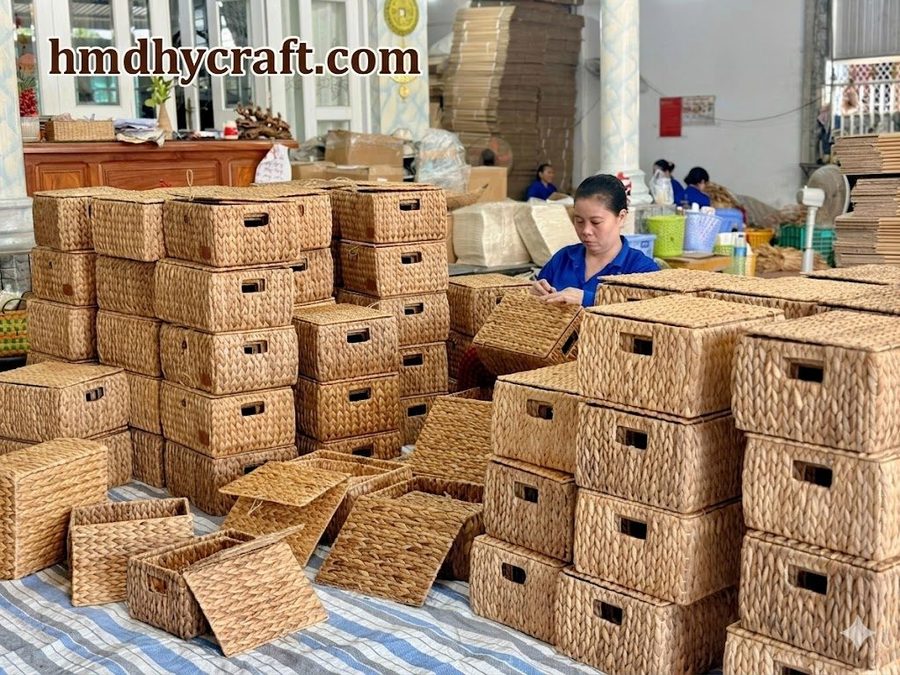
Six weeks of production for a standard 40'HQ container of standard designs. Weaving groups produce against the approved sample. Mid-production check happens around W11 with photos or video sent to the buyer. Around W13 units start moving to the HCMC consolidation facility for industrial drying (moisture below 15 percent), anti-mould treatment, hand QC, and packing to spec. Third-party inspection (SGS, TÜV) if requested happens around W13-14.
Container loading FOB Ho Chi Minh City
20' or 40'HQ container loaded at Cat Lai or Cai Mep. Loading is documented with photos and video. Commercial invoice, packing list, Certificate of Origin, phytosanitary certificate prepared. Balance payment (70 percent T/T) received. Bill of Lading released.
Ocean freight and destination clearance
US West Coast: 14 to 21 days transit. US East Coast: 28 to 35 days. UK/EU: 28 to 35 days. Australia: 14 to 21 days. Destination customs clearance and inland trucking add 3 to 10 days depending on port and destination warehouse.
Where the calendar actually gets lost
The 16-week model assumes both sides move on time. In practice, most delays trace to one of four places:
- Ambiguous first-week spec. "Similar to this reference" is not a spec. The exporter guesses in W2 and the buyer corrects in W4, adding a round.
- Slow sample review. Buyers who take three weeks to review a sample give away three weeks of calendar.
- Late deposit. Some buyers approve the sample and then take two weeks to release the deposit through their finance team. Production cannot start on a promise.
- Peak-season overload. August to November, weaving village capacity is fully booked. New buyers sit behind repeat programs. Lead times extend 10 to 15 days.
Peak season vs off-season timing
| Period | Calendar impact | What is going on |
|---|---|---|
| January to April (off-season) | Standard 100-130 day timeline | Weaving villages have capacity. Sample rounds turn faster. Good time to start a first program. |
| May to July (pre-peak) | +5 to 10 days | Peak-season orders are booking. Sample rounds compete with production planning. |
| August to November (peak) | +10 to 20 days | US and EU holiday retail programs consume weaving capacity. Sample rounds slow to 15 to 20 days. New buyers behind repeat programs. |
| December (post-peak) | Standard, but Lunar New Year approaching | Production winds down. Lunar New Year holiday (late Jan or early Feb) closes weaving villages for 2 to 3 weeks. Plan around it. |
If your delivery date is fixed (holiday retail set, seasonal storefront reset, e-commerce catalogue launch), work backwards 16 to 19 weeks and start the enquiry then. If you start the enquiry in July for October delivery, the calendar will not stretch. Peak-season demand is not something an exporter can compress; it is the physical reality of hand-weaving.
Repeat buyer timeline — 10 to 13 weeks
Once you have approved samples on file and the supplier knows your packing, hangtag, and QC standards, the timeline collapses:
W1: Enquiry with SKU list and quantities. Quote back in 2 days.
W2: PO issued, deposit received. Refresher sample sent if any small change (colour tone, minor dim adjustment). No full sample round unless design changes.
W3-8: Production (6 weeks). Standard.
W9: QC and loading.
W10-13: Ocean freight.
This is why suppliers value repeat buyers. The math works better for both sides.
The fastest lead time on a first order is the one that spent its first week on a precise spec instead of a fast reply.
Every accelerated timeline I have seen came from clarity on day one, not from pushing the workshop harder in week ten. Hand-weaving does not compress the way factory production does. The compression happens up front, in the enquiry.