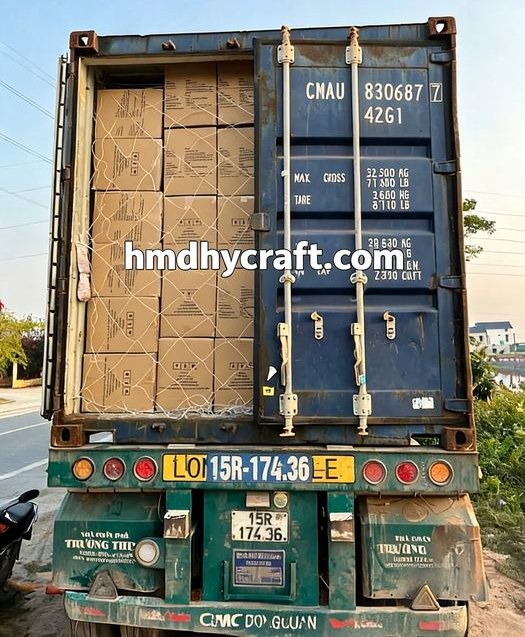
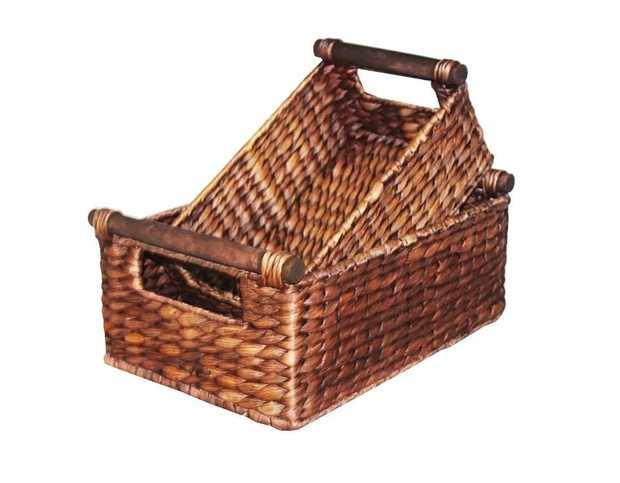
Getting a US Customs entry right on Vietnamese handwoven baskets is not complicated, but the ways it goes wrong are consistent and expensive. Wrong HTS code, missing "Made in Vietnam" marking, undervaluation flag, or the broker files under a different tariff heading and duty jumps from 4.5 percent to 8.3 percent. This piece is the practical CBP entry playbook for US importers on HS 4602 basketwork.
Written for US-based buyers importing handwoven baskets from Vietnam. Covers correct HTS classification, GSP status (currently lapsed), MFN duty rates, ACE entry workflow, common CBP challenges, and country-of-origin marking. Applies to water hyacinth, seagrass, bamboo, and rattan basketwork.
The correct 10-digit HTS code for water hyacinth baskets
US HTS classification for handwoven basketwork sits under Chapter 46 — Manufactures of straw, esparto, or other plaiting materials. Heading 4602 covers basketwork specifically. The 10-digit codes that matter for Vietnamese basket imports:
| HTS code | Product | MFN duty |
|---|---|---|
| 4602.11.4500 | Basketwork of bamboo, other | 4.5% |
| 4602.12.4500 | Basketwork of rattan, other | 4.5% |
| 4602.19.4500 | Basketwork of other vegetable materials (incl. water hyacinth, seagrass), other | 4.5% |
| 4602.19.1600 | Luggage of vegetable plaiting materials | 5.3% |
| 4602.19.6000 | Wickerwork luggage, handbags, purses | 8.3% |
| 4602.19.8000 | Basketwork of other vegetable materials, wickerwork | 6.6% |
The distinction that catches most brokers: a "basket" and a "luggage-style basket" are different HTS classifications. A retail storage basket that a shopper uses for closet organisation is 4602.19.4500 (4.5% duty). A basket that looks like or functions like luggage (has a lid, handles designed for carrying with weight, and is marketed for travel) is 4602.19.6000 (8.3% duty). Getting this distinction right saves 3.8 percentage points on the duty base — meaningful on any container-scale import.
HMD includes the recommended 10-digit HTS code on every commercial invoice for US-bound shipments. The US customs broker is not obligated to file under HMD's recommendation but should have a well-founded reason to override it. If the broker files under a different code without discussion, ask why.
GSP status — currently lapsed, keep documentation
The US Generalized System of Preferences (GSP) lapsed on December 31, 2020, and has not been reauthorized by Congress as of 2026. When GSP was active, Vietnamese handwoven basketwork was GSP-eligible under HTS 4602 subheadings A-designated for preferential treatment — meaning zero duty instead of the 4.5 percent MFN rate.
If GSP is reauthorized (bills to reauthorize have been introduced in every Congress since lapse), historically the reauthorization includes retroactive refund provisions covering the lapse period. Importers who filed entries during the lapse can request refund of GSP-eligible duty paid, typically within a 12-month window after reauthorization takes effect.
Practical advice: file entries at the MFN rate now (that is the current legal duty), and keep the entry documentation for potential retroactive refund. HMD's commercial invoice always includes the GSP eligibility indicator ("Country of origin: Vietnam, HTS 4602.19.4500, GSP program A-eligible when program active") so brokers and importers can file the refund claim quickly if GSP returns.
What the ACE entry looks like
ACE (Automated Commercial Environment) is CBP's electronic entry filing system. All formal entries above $2,500 shipment value are filed through ACE by a licensed customs broker. The broker files an Entry Summary (CF-3461) within 15 CBP working days of arrival. Key fields on the entry:
| ACE field | Value for typical basket import | Common error |
|---|---|---|
| HTS code (10-digit) | 4602.19.4500 (water hyacinth basketwork) | Broker files 4602.19.6000 (luggage rate) or 6304.99 (textile home decor) |
| Country of origin | VN (Vietnam) | Consolidator address triggers CN (China) filing |
| Manufacturer/Shipper | HMD Strategy & Export or supplier of record | Blank or wrong name causes AD/CVD review flag |
| Value (FOB dutiable) | Commercial invoice FOB HCMC total | CIF value used incorrectly, inflating dutiable base |
| Quantity (units + supplementary UOM) | Piece count per HTS line | Carton count filed instead of piece count |
| Marking compliance | Country of origin marking verified | Missing "Made in Vietnam" on retail unit triggers marking notice |
Filed correctly, entries clear in 24 to 72 hours in the normal case. Duty is paid through the importer's ACH debit account or PMS (Periodic Monthly Statement). Container releases to inland transport once entry is accepted and duty settled.
Country of origin marking — the check that catches informal shipments
Every retail unit imported into the US must be marked with its country of origin in a "conspicuous place as legibly, indelibly, and permanently as the nature of the article permits". For handwoven baskets, this typically means:
- Paper hangtag with "Made in Vietnam" attached to the basket by cotton string. Acceptable for most retail baskets. Hangtag must be attached in a way that requires visible effort to remove — not just loose.
- Stick-on label on the base of the basket with "Made in Vietnam" printed. Acceptable if the label uses a permanent adhesive that does not peel off with light handling. Removable price-sticker adhesive does NOT meet the marking requirement.
- Embossed or printed marking directly on a wooden component (handle, base). The most permanent option and required for pieces intended for higher-end retail where the hangtag would be discarded.
- Marking on the retail packaging (if the retail unit is sold in its packaging). Acceptable only if the packaging is the retail-facing surface — a plain shipping carton does not qualify.
Missing or non-compliant marking triggers a marking notice (CBP Form 4647) at entry. The shipment cannot release until either the marking is corrected under CBP supervision (typically at a bonded warehouse, at importer expense) or the container is exported back to origin. Marking correction at bonded warehouse runs $2 to $6 per retail unit — enough to eliminate margin on a first shipment if the entire container needs re-marking.
HMD applies country of origin marking on every SKU at packing. The default is a paper hangtag reading "Made in Vietnam · HMD Hycraft". Buyers with private-label branding can specify the hangtag design; the "Made in Vietnam" marking must be preserved.
Undervaluation flags — the CBP audit trigger most importers do not know
CBP maintains internal price benchmarks for imported goods by product category and origin country. When an entry's declared FOB value falls significantly below the benchmark, ACE flags the entry for manual review — sometimes at entry, sometimes months later through a CBP-issued Request for Information (CBP Form 28).
For Vietnamese basketwork under HTS 4602, the CBP benchmark FOB value is roughly $4 to $22 per piece depending on size, complexity, and material. Entries with declared unit values below $2 per piece almost always flag for review. Undervaluation review typically resolves with the importer providing the commercial invoice, purchase order, and payment records demonstrating that the declared value is the true transaction price.
Where undervaluation is confirmed, CBP assesses supplemental duty on the difference plus interest, plus potential penalties. Where the declared value is the true transaction price, no action is taken — but the review adds 30 to 90 days of administrative work.
HMD's FOB pricing sits within CBP's typical benchmark range for Vietnamese basketwork. Buyers who receive a Form 28 on an HMD shipment can respond with the standard commercial invoice, PO, and T/T payment records — the review typically resolves within 45 days with no supplemental duty.
Physical exam — the 1-in-20 that costs $250 to $600
CBP examines physically roughly 5 percent of handwoven basket containers; the rest clear on documentation review. A physical exam is triggered by risk-scoring at entry (undervaluation flag, HTS ambiguity, origin ambiguity, importer's history of prior issues, or a random-selection algorithm). Physical exams add 3 to 7 days and cost $250 to $600 in exam fees paid by the importer.
Common physical exam findings on Vietnamese basketwork:
- Country of origin marking non-compliance. Most common finding. Retail units without visible or permanent "Made in Vietnam" marking.
- HTS misclassification. Second most common. Broker filed 4602.19.4500 but the pieces are luggage-style at 4602.19.6000. CBP reclassifies and assesses supplemental duty.
- ISPM 15 non-compliance on wooden pallets. Pallets in the container without HT/MB stamp and IPPC logo. HMD floor-loads containers without wooden pallets by default; this exam finding does not apply to HMD shipments.
- Undeclared components. Batteries, lights, or electrical components inside decorative baskets. Not typical for HMD product line but flagged if found.
The single most expensive US import mistake on baskets
Filing under HTS 4602.19.6000 (luggage rate, 8.3%) when the goods should be 4602.19.4500 (basketwork rate, 4.5%). On a $30,000 FOB shipment, the difference is $1,140 in overpaid duty — recoverable through post-summary correction but with 60 to 120 days of administrative overhead. Brokers unfamiliar with the basketwork/luggage distinction default to the higher rate to avoid CBP audit risk. If HMD's commercial invoice recommends 4602.19.4500 and the broker files 4602.19.6000, ask for the classification reasoning in writing before accepting.
Practical US importer setup checklist
- 1.Register your Importer of Record number. If new, apply for a Customs Assigned Number (CAN) or use your business EIN.
- 2.Retain a licensed customs broker. Standard broker fee $150-$350 per entry. National brokers (CH Robinson, Expeditors) or regional specialists both work; specialists often price cheaper on repeat handwoven basket entries.
- 3.Set up ACH debit for duty payment. Or use Periodic Monthly Statement (PMS) for consolidated monthly payment.
- 4.Brief the broker on HTS 4602 specifically. Confirm they file 4602.19.4500 for water hyacinth basketwork by default.
- 5.Verify country of origin marking on samples. Before first container, confirm every SKU has permanent "Made in Vietnam" marking that CBP will accept.
- 6.Archive entries for 5 years. CBP audit window is generally 5 years from date of entry.
Right HTS code, right marking, right value — three lines that keep every entry smooth.
Frequently asked questions
What is the correct HTS code for water hyacinth baskets from Vietnam?
HTS 4602.19.4500 for basketwork of other vegetable materials. For bamboo use 4602.11.4500; for rattan use 4602.12.4500. All at 4.5% MFN duty.
Is Vietnam eligible for GSP treatment on HS 4602?
US GSP lapsed Dec 31, 2020, not reauthorized as of 2026. Vietnamese basketwork enters at MFN rates. Keep documentation for potential retroactive refund if reauthorized.
What is the current MFN duty rate on HS 4602 baskets?
4.5% for standard basketwork subheadings. Luggage-style 4602.19.6000 at 8.3%. Duty on FOB value (not CIF).
What triggers CBP to challenge a HS 4602 entry?
HTS code mismatch, misclassification within 4602 (basketwork vs luggage), or undervaluation flag when FOB is significantly below CBP benchmark.
What is ACE and does my broker need to file through it?
ACE is CBP's electronic entry system. Formal entries (>$2,500) require broker filing through ACE. Broker fees $150-$350 per entry.
How does CBP inspect handwoven basket imports?
~1 in 20 containers physically examined. Adds 3-7 days, $250-$600 exam fees. Common findings: marking non-compliance, HTS misclassification, ISPM 15 pallet issues.