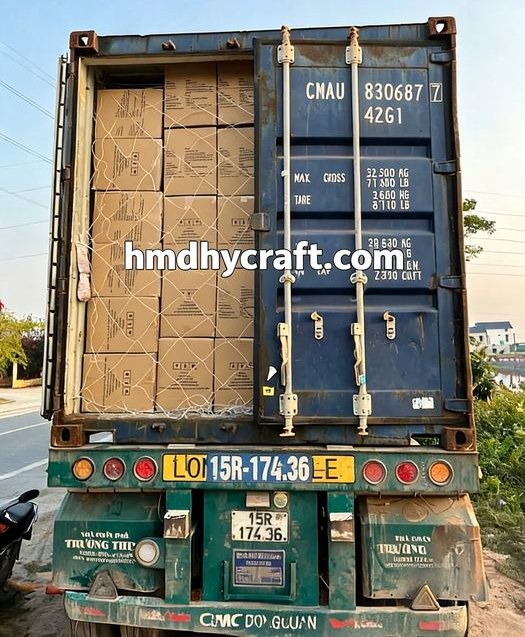
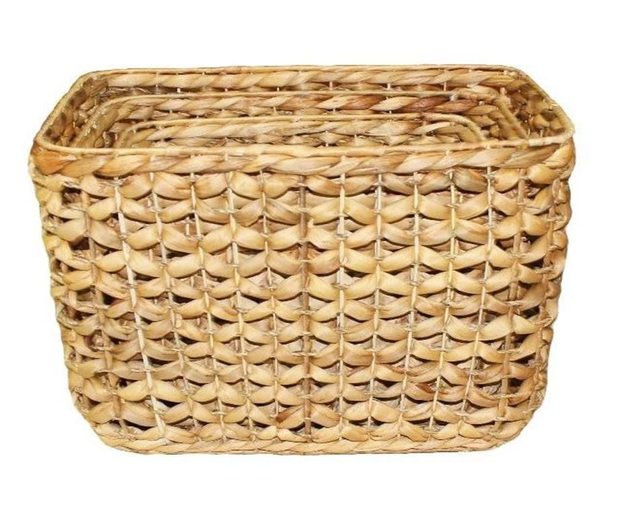
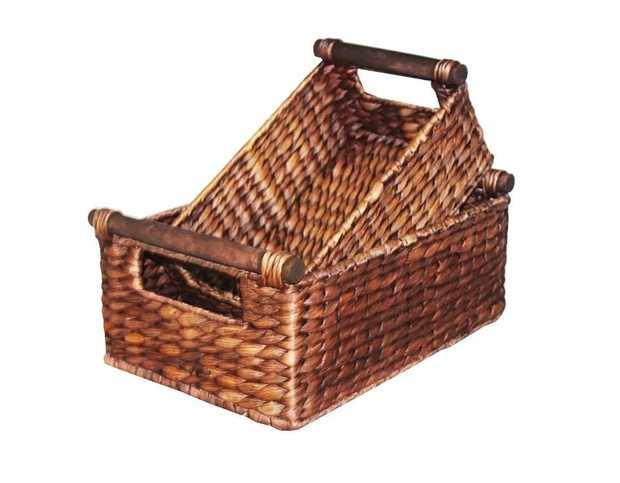
Japan is one of the strictest importing countries in the world for anything made partly of wood. A container of handwoven baskets that flies through Rotterdam or Long Beach in 48 hours can sit at Yokohama for a week because the wooden handles on one SKU triggered a Plant Protection Station inspection. The rules are consistent and predictable — but they punish first-time exporters who did not know they applied. This piece is what a Japanese buyer, or a supplier planning a first Japan shipment, needs to have set up before container loading.
Written for Japanese import buyers evaluating Vietnamese handwoven basket suppliers, and for exporters preparing a first Japan-bound container. The requirements apply to any handwoven basket product with wooden handles, internal wood frames, wooden bases, or decorative wood accents — which is roughly 30 to 40 percent of the standard basket catalogue.
Two distinct wood rules Japan applies
Japanese customs applies two separate wood-related rule sets, and buyers frequently confuse them:
- Rule 1 — Plant Protection Act on PRODUCT wood. The wood that IS the product (or part of it). A basket with wooden handles, wooden internal frames, or wooden bases falls here. Requires a phytosanitary certificate from the exporting country's plant protection authority, and inspection by Japan's Plant Protection Station (PPS) at port of entry. This is the rule that matters for most basket imports.
- Rule 2 — ISPM 15 on PACKAGING wood. The wood used for pallets, crates, and dunnage that carries the product. Regulated by ISPM 15 international standard. Any wooden pallet or dunnage in the container must be heat-treated (HT) or fumigated (MB), stamped with the IPPC logo, treatment code, and country code (VN for Vietnam). This is the rule that catches out buyers who assume "wood is wood" — the pallet under the cargo is regulated separately from the cargo itself.
A basket container can simultaneously fail both rules: the baskets have wooden handles (Rule 1 — needs phytosanitary) AND the container was loaded on non-ISPM-15-marked pallets (Rule 2 — needs treatment or removal). Cleared containers meet BOTH rules. Failed containers get held at port until either the buyer arranges fumigation at destination (adds $600 to $1,400 and 5 to 8 days) or the shipment is refused entry.
What counts as "product wood" on a handwoven basket
| Component | Wood? | Phytosanitary required? |
|---|---|---|
| Water hyacinth weave | No (plant fibre, not wood) | Not required (though Japan sometimes still asks) |
| Seagrass weave | No (marine sedge fibre) | Not required |
| Bamboo weave | Grass, not wood botanically | Not required by Plant Protection Act, but Japanese customs sometimes treats as wood |
| Rattan (whole pole, not split) | Wood-like palm stem | Yes |
| Wooden handle (acacia, eucalyptus, oak) | Yes, hardwood | Yes |
| Wooden internal frame ring | Yes, if wood (some are rattan) | Yes if wood |
| Wooden base plate | Yes | Yes |
| Decorative wooden buttons or toggles | Yes | Yes, even in small quantity |
| Cotton liner | No (textile) | Not required |
| Metal frame or hardware | No | Not required |
Even a decorative wooden button counts. Japan does not have a de-minimis threshold — one wooden component makes the SKU a "wood-containing product" for phytosanitary purposes. Practically, HMD sorts SKUs into two categories at PO stage: wood-containing SKUs (get phytosanitary certificate) and non-wood SKUs (do not need it). Container shipments that include any wood-containing SKUs get a phytosanitary certificate covering the whole shipment.
The phytosanitary certificate process at the Vietnamese end
Phytosanitary certificates for Vietnamese exports are issued by the Plant Protection Department (Cục Bảo vệ Thực vật), the plant protection authority under Vietnam's Ministry of Agriculture and Rural Development (MARD). The certificate confirms that the wood component has been inspected, is free of harmful organisms, and meets the destination country's phytosanitary requirements.
Process from HMD's perspective:
- 1.PO stage: HMD flags wood-containing SKUs against the packing spec.
- 2.Pre-production: Confirm wood species with the supplier (acacia and eucalyptus are the standard for basket handles from Vietnamese workshops).
- 3.Pre-shipment (5-7 days before container loading): HMD submits phytosanitary application to Plant Protection Department with the commercial invoice, packing list, wood species declaration, and destination country (Japan).
- 4.Inspection at consolidation warehouse: Plant Protection Department officer physically inspects sample pieces (typically 10 percent of wood-containing SKUs) for pests, larvae, fungal growth, bark residue.
- 5.Certificate issued: Phytosanitary certificate issued 1 to 2 working days after inspection. Physical original travels with the shipping documents; electronic PDF emailed to the Japanese buyer's freight forwarder.
Cost: roughly 500,000 to 1,200,000 VND per shipment (about $20 to $50) depending on wood content. HMD includes this in the export documentation fee bundled with the FOB quote — it is not a separate line item on the invoice.
Inspection at Japanese port of entry
Container arrives at a Japanese port (Yokohama, Kobe, or Osaka for typical basket import routes). Plant Protection Station (PPS) officers select 5 to 10 percent of cartons for physical inspection. Sample pieces are examined for live pests, larvae, fungal growth, and bark residue. The phytosanitary certificate is cross-checked against the shipping manifest.
Standard clearance: 1 to 3 working days. Findings that trigger action:
| Finding at inspection | Action | Cost + delay |
|---|---|---|
| Clean — no pests or defects | Release | None |
| Bark residue on wooden handles (common) | Fumigation order (methyl bromide) or return-to-origin | 80,000-150,000 JPY, 5-8 days |
| Live insect or larva found | Mandatory fumigation OR destruction of affected pieces | Fumigation cost + destruction cost |
| Certificate mismatch (SKU count, weight, or species differs from cert) | Hold for documentation clarification; resubmission of certificate | 3-5 days delay, no fee |
| Fungal growth on wood | Mandatory fumigation OR treatment at bonded warehouse | 100,000-200,000 JPY, 7-10 days |
The most common finding on Vietnamese basket imports is bark residue on wooden handles — bark fragments not fully removed during handle preparation. Prevented at Vietnamese-end QC by verifying every wooden handle is fully de-barked and smooth to touch before packing. HMD's pre-shipment QC includes this check as line item 8 of the standard 14-point inspection.
ASEAN-Japan CEPA preferential duty (Form AJ)
Separate from phytosanitary — the ASEAN-Japan Comprehensive Economic Partnership Agreement (AJCEP) provides preferential duty on Vietnamese exports to Japan. For HS 4602 handwoven basketwork, the MFN Japanese duty is around 3.9 to 6.7 percent depending on specific subheading; under AJCEP with Form AJ certificate of origin, the rate is 0 percent (zero) for Vietnamese origin.
Form AJ is issued by the Vietnamese Ministry of Industry and Trade (MoIT) through the eCoSys system — the same portal that issues Form A for UK/EU DCTS. Application takes 1 to 3 working days after commercial invoice finalisation. HMD applies for Form AJ on every Japan-bound shipment as standard.
The DCTS-equivalent saving for Japanese imports on a mid-scale programme is meaningful — 3.9 to 6.7 percent of CIF value goes to the buyer's P&L instead of Japanese Customs. On a 5,000,000 JPY CIF shipment that is roughly 200,000 to 335,000 JPY per container of duty saved.
JAS — when it does and does not apply
JAS (Japan Agricultural Standards) is Japan's voluntary quality standard for agricultural and forestry products. JAS certification appears on structural lumber, plywood, and some specific engineered wood products marketed domestically in Japan. It is not a customs requirement for imports.
Handwoven baskets do not typically pursue JAS certification because the wood volume per unit is far below the threshold where certification adds commercial value. A basket with a 200-gram wooden handle does not benefit from being made of JAS-graded acacia — the certification cost per unit far exceeds any consumer willingness-to-pay premium.
However, some Japanese premium-retail buyers request JAS-graded hardwood for handle components as a positioning signal (particularly for retail SKUs at retail price above 5,000 JPY). HMD sources handle wood from JAS-certified suppliers on request; the surcharge is roughly 8 to 12 percent on the handle component and negligible on the full basket price.
ISPM 15 for pallets and dunnage
Separate requirement from product-wood phytosanitary. Any wooden pallet, crate, or dunnage in the container must meet ISPM 15: heat-treated (HT) or fumigated (MB), stamped with the IPPC logo, treatment code, and Vietnam country code (VN).
HMD's default is to floor-load containers directly on the container floor without wooden dunnage. This eliminates the ISPM 15 concern entirely — no wooden packaging, no ISPM 15 to worry about. Buyers who need palletised shipping (typically for automated DC handling at destination) receive ISPM-15-marked EUR pallets or export pallets; HMD sources from ISPM-15-certified pallet suppliers and includes copies of the pallet treatment certificates with the shipping documents.
Bark residue — the single most common Japan basket-import rejection
Roughly 6 to 8 percent of Vietnamese basket shipments to Japan get flagged at PPS inspection for bark residue on wooden handles. The fix is upstream: at the Vietnamese consolidation warehouse, every wooden handle is physically inspected under torch light for bark fragments, and any handle with visible bark is either re-sanded or the SKU is pulled from the shipment. HMD's pre-shipment QC line item 8 catches this before container loading. Buyers importing from other Vietnamese suppliers should verify this specific check is done, or expect a fumigation order on roughly 1 in 15 shipments.
Japanese buyer's document checklist for basket imports
- Commercial invoice with HS code, SKU list, unit price, quantity, total value.
- Packing list with cartons per SKU, gross and net weight, dimensions, wood component declaration per SKU.
- Bill of Lading direct HCMC to Japanese port.
- Form AJ certificate of origin (ASEAN-Japan CEPA) for zero-duty entry.
- Phytosanitary certificate from Vietnamese Plant Protection Department for wood-containing SKUs.
- ISPM 15 compliance evidence for wooden pallets if used (or written declaration of "no wood packaging" if floor-loaded).
- Fumigation certificate (optional, but some Japanese buyers request Vietnamese-issued fumigation for the entire shipment as a precaution — valid 21 days).
HMD ships all of the above with the container documents. The Japanese buyer's broker files the import declaration through NACCS (Nippon Automated Cargo and Port Consolidated System). Standard clearance including phytosanitary inspection: 3 to 5 working days from container arrival to release for inland delivery.
Japan is not harder to import into. It is just more disciplined about what it asks for.
Buyers who set up the phytosanitary process correctly on the first Japan container shipment discover that every subsequent shipment runs on the same paperwork with almost no incremental overhead. The Vietnamese Plant Protection Department knows HMD, HMD knows Japanese PPS expectations, and the buyer's Japanese broker knows the NACCS entry pattern. First-order friction is high; second-order onward is smooth.
Frequently asked questions
Do handwoven baskets need a phytosanitary certificate to enter Japan?
Yes for any SKU with a wooden component (handle, frame, base, decorative accent). Water hyacinth/seagrass-only SKUs technically do not need it but many buyers request one for consistency.
What is ISPM 15 and does it apply to baskets?
ISPM 15 governs wooden packaging (pallets, crates, dunnage), not product wood. Basket's own wooden handle needs a phytosanitary certificate, not ISPM 15 marks.
What kinds of wooden components appear on handwoven baskets?
Wooden handles (acacia/eucalyptus most common), internal frame rings, wooden bases, decorative wooden buttons or toggles, hamper lid handles. Any of these triggers phytosanitary requirement.
How does Japan Plant Protection Station inspect basket imports?
5-10% cartons opened at Yokohama/Kobe/Osaka. Inspection for live pests, larvae, fungal growth, bark residue. Standard clearance 1-3 working days.
Does JAS (Japan Agricultural Standards) apply to handwoven baskets?
Voluntary quality standard, not a customs requirement. Handwoven baskets rarely pursue JAS certification because wood volume per unit is below the threshold where certification adds commercial value.
What documentation does the Japanese importer need at customs?
Commercial invoice, packing list, B/L, Form AJ (ASEAN-Japan CEPA COO for zero duty), phytosanitary certificate for wood SKUs, ISPM 15 evidence for wooden pallets if used.