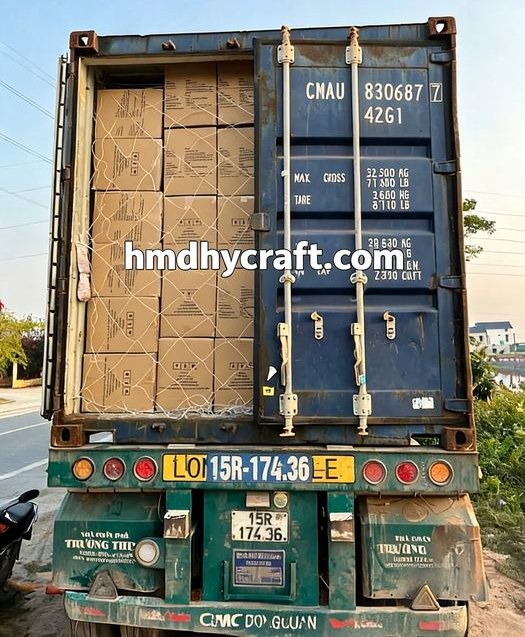
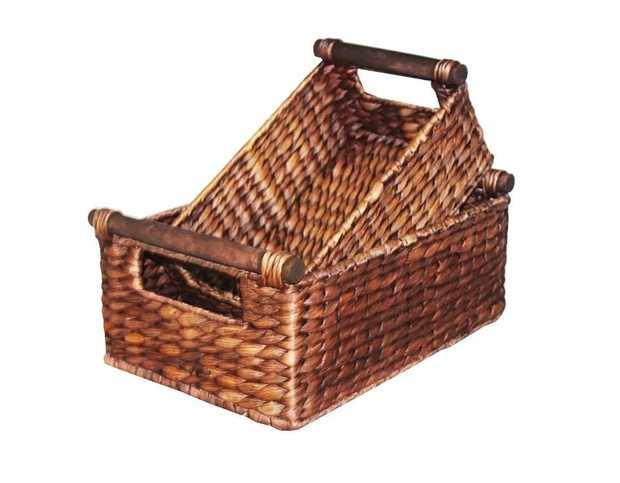
Germany is the second-largest European market for Vietnamese handwoven basketwork after the UK. The customs mechanics are straightforward — EVFTA zero duty, 19 percent VAT, standard EU import controls. The paperwork most first-time German buyers miss is not at customs. It is VerpackG — the packaging law that requires every commercial importer to register with LUCID and license their packaging weights. Miss VerpackG and the container clears customs fine; the German competition authority later assesses a €10,000 to €200,000 fine.
Written for German-based buyers importing handwoven baskets from Vietnam, and for EU buyers using Germany as their EU entry point. Covers EORI setup, EVFTA preferential duty, import VAT, ATLAS declaration through Hamburg or Bremerhaven, and the VerpackG compliance chain that catches most first-time importers off guard.
The four German-specific paperwork items
Ordered by when they matter in the import lifecycle:
| Item | When | Where to obtain | Cost |
|---|---|---|---|
| EORI (Economic Operator ID) | Before first import | Generalzolldirektion online | Free, 3-5 working days |
| EVFTA proof of origin (EUR.1 or self-declaration) | With every shipment | Vietnamese Ministry of Industry & Trade via HMD | Included in HMD export docs |
| Import VAT (Einfuhrumsatzsteuer) | At ATLAS entry | Paid to German customs at declaration | 19% of CIF value |
| LUCID VerpackG packaging registration | Before first placing on German market | Zentrale Stelle Verpackungsregister (ZSVR) | Free registration + dual-system licensing fees |
All four are the buyer's obligation, not the Vietnamese exporter's. HMD provides the EVFTA proof of origin, complete commercial documentation, and packaging composition data that the buyer needs for LUCID licensing. Everything else the buyer sets up before the first container arrives.
EVFTA zero duty — the €1,000+ saving per typical container
The EU-Vietnam Free Trade Agreement entered force on 1 August 2020. HS 4602 handwoven basketwork was included in the zero-duty schedule from entry-into-force (no phased reduction). Standard MFN duty on 4602 basketwork is 3.7 percent; under EVFTA the rate is 0 percent for goods of Vietnamese origin.
Two proof-of-origin mechanisms under EVFTA:
- EUR.1 movement certificate issued by Vietnamese Ministry of Industry and Trade (MoIT) through the eCoSys system. Required for shipments above €6,000 value. Physical original travels with shipping documents; electronic PDF filed with ATLAS declaration. Same eCoSys system that issues Form A for UK/DCTS and Form AJ for Japan/CEPA.
- Exporter self-declaration on invoice for shipments up to €6,000. Vietnamese exporter must be REX-registered (Registered Exporter system) and include the declaration text with REX number on the commercial invoice. Faster than EUR.1 but only usable below the €6,000 threshold.
HMD is REX-registered and issues EUR.1 on every EU-bound shipment above €6,000, invoice self-declaration below. Buyer's German customs broker files under EVFTA preference (preference code 200 in ATLAS) with the appropriate document code (N954 for EUR.1). Zero duty applied automatically.
Import VAT — the cash flow mechanism that catches new importers
German import VAT is 19 percent of CIF value plus any duty. For EVFTA zero-duty entries: 19 percent of CIF only. On a typical container:
| CIF value (€) | Import VAT (19% × CIF) | Reclaimable if VAT-registered? |
|---|---|---|
| €8,000 (LCL first order) | €1,520 | Yes, through UStVA return |
| €15,000 (partial 40HQ) | €2,850 | Yes |
| €28,000 (comfortable 40HQ) | €5,320 | Yes |
| €48,000 (full 40HQ) | €9,120 | Yes |
Import VAT is paid at ATLAS declaration and reclaimed on the buyer's next VAT return (Umsatzsteuervoranmeldung — UStVA), typically 30 to 60 days later. Cash flow neutral over the medium term, but a real short-term cash requirement — buyers importing multiple containers per quarter should plan for €5,000 to €15,000 of import VAT tied up in the reclaim cycle at any given time.
Two options to defer or eliminate the cash impact:
- Aufschubkonto (deferment account) with German customs. Duty and VAT settled monthly rather than at each entry. Standard for volume importers; requires bank guarantee.
- Section 21a EU VAT deferral where the importer's forwarder acts as fiscal representative and VAT deferred to the domestic supply stage (as if the goods were purchased inside Germany). Most Rotterdam-forwarded shipments entering Germany use this route via a Dutch fiscal representative to skip German import VAT entirely at the border.
VerpackG — the compliance most first-time importers miss
The Verpackungsgesetz (VerpackG — German Packaging Act, effective 1 January 2019, revised 2022) requires every company that first places packaged goods on the German market to:
- 1.Register with the LUCID public register maintained by ZSVR (Zentrale Stelle Verpackungsregister). Registration is free, done through the LUCID web portal, typically issued within 2 to 3 working days.
- 2.License the packaging quantities with a licensed dual system (Grüner Punkt / Der Grüne Punkt, Interseroh+, Landbell, Reclay, Zentek, and several others). The dual system collects, sorts, and recycles the packaging waste on behalf of the importer.
- 3.Submit annual quantity declaration (Vollständigkeitserklärung) to LUCID declaring the total weight of each packaging category placed on the German market during the reporting year.
For a typical handwoven basket import programme, the packaging categories that need licensing are:
| Item | Category | Typical weight per basket unit |
|---|---|---|
| Paper hangtag with "Made in Vietnam" and brand | Paper/paperboard | ~5 grams |
| Cotton string on hangtag | Composite (or exempt if under threshold) | ~1 gram |
| Retail carton (if basket is sold pre-boxed) | Paperboard | ~120 grams per SKU depending on size |
| Polybag (for FBA-style baskets) | Plastic | ~8 grams |
| Kraft tissue paper inside carton | Paper | ~3 grams |
| Master shipping carton (transport packaging) | Exempt from LUCID licensing | — |
Dual-system licensing fees are calculated by material category and total annual weight. Rough figures: paperboard ~€0.28/kg, plastic ~€1.20/kg, composite ~€0.60/kg, glass ~€0.08/kg. For a mid-scale basket importer moving 5,000 pieces per year with typical packaging, annual dual-system fee is approximately €80 to €200 — a rounding error against margin but a mandatory compliance line.
Non-compliance penalties are the real risk. Placing packaged goods on the German market without LUCID registration is a competition law violation. Fines run €10,000 to €200,000 per case. More materially, non-registered products can be subject to a distribution ban — meaning German retail partners (particularly larger chains) refuse to stock the goods once they discover the LUCID registration is missing.
What HMD provides to help the buyer's LUCID compliance
HMD provides a Packaging Composition Declaration for every EU-bound shipment on request. The document lists, per SKU: paperboard weight per unit (hangtag + carton + tissue), plastic weight per unit (polybag if used), composite weight per unit (string), and total weight of each packaging category shipped. Buyer feeds these numbers into the LUCID annual declaration and the dual-system quantity report.
The declaration is not a customs document and does not travel with the container. It is emailed to the buyer separately at shipping stage. Some larger buyers prefer to receive it as a quarterly summary rather than per-shipment.
ATLAS declaration and Hamburg / Bremerhaven clearance
Vietnamese basket containers to Germany typically arrive at Hamburg (largest German port), Bremerhaven, or occasionally Rotterdam (with inland transit to Germany). Ocean transit: 35 to 45 days from HCMC. German customs entry is filed through ATLAS (Automatisiertes Tarif- und Lokales Zoll-Abwicklungs-System) by the buyer's German customs broker.
Standard ATLAS entry fields for HS 4602 basketwork:
| ATLAS field | Value for Vietnamese basket import under EVFTA |
|---|---|
| Commodity code (CN 8-digit + national 2-digit) | 4602 1990 90 (basketwork, other vegetable materials) |
| Country of origin | VN (Vietnam) |
| Country of dispatch | VN |
| Preference code | 300 (EVFTA) |
| Document code | N954 (EUR.1) or U164 (REX self-declaration) |
| Statistical value | CIF (converted to EUR at daily rate) |
Filed correctly, clearance runs 1 to 3 working days. Physical exam rate on HS 4602 from Vietnam is low (roughly 1 in 30 containers). Exam findings, when they occur, are usually ISPM 15 pallet compliance (HMD floor-loads to avoid this) or minor documentation gaps.
The German import checklist for a first shipment
Before first container arrival: apply for DE EORI, register with LUCID, sign contract with a dual system (Grüner Punkt or one of the alternatives), brief customs broker on EVFTA preference code 300 + document code N954, set up import VAT reclaim account or arrange fiscal representative for section 21a deferral. All of the above is one-time setup; every subsequent shipment runs on the same infrastructure.
Germany's customs are simple. Its packaging law is the trap.
Buyers who set up the four items (EORI, EVFTA workflow, VAT mechanism, LUCID + dual system) before the first container find German imports run as smoothly as any EU market. Buyers who skip LUCID and discover it later can face fines that dwarf the entire margin on the first year of German sales — this is the one German-specific item worth setting up before the first PO, not after.
Frequently asked questions
What is VerpackG and does it apply to imported baskets?
Yes. Every commercial importer of packaged goods into Germany must register with LUCID (ZSVR) and license packaging quantities through a dual system. Fines €10K-€200K + distribution ban for non-compliance.
What is the duty rate on Vietnamese baskets entering Germany?
0% under EVFTA with EUR.1 or exporter self-declaration (below €6,000). MFN rate 3.7% without EVFTA proof.
How does German import VAT work on basket shipments?
19% Einfuhrumsatzsteuer on CIF value. Reclaimable via UStVA VAT return for registered importers. Deferrable via Aufschubkonto or section 21a fiscal representative.
Do I need an EORI number to import into Germany?
Yes. Free from Generalzolldirektion, 3-5 working days. Existing EU EORI from another member state also works.
What packaging materials count under VerpackG for a basket shipment?
Hangtag (paper), string (composite), retail carton (paperboard), polybag (plastic), tissue (paper). Master shipping cartons are transport packaging and exempt.
What is the practical timeline from PO to Hamburg or Bremen arrival?
6-8 weeks production + 4-6 days origin customs + 35-45 days ocean transit + 2-4 days ATLAS clearance = 12-16 weeks PO-to-DC for a first shipment.