I run an export business from Vietnam, so treat this as a Vietnamese exporter's view of the map. That said, buyers ask me every week where they should source natural-fibre home décor from in 2026. I owe them an honest answer, including where I would send them to somebody else.
This piece covers the three main origins for handwoven natural-fibre home décor sold into Western retail: Vietnam, China, and Indonesia. It is written for category managers, product developers, and buyers looking at where to place their next handicraft program.
The 2026 map at a glance
| Factor | Vietnam | China | Indonesia |
|---|---|---|---|
| Strongest categories | Water hyacinth, seagrass, bamboo, mixed-fibre décor | Wire-framed and hybrid baskets, plastic-and-fibre mixes, high-volume basics | Rattan poles and furniture, water hyacinth (secondary), teak accessories |
| Unit price band (equal SKU) | Low to mid | Low, but tariff-loaded for US buyers | Mid to high on rattan; comparable to VN on water hyacinth |
| US tariff exposure (HS 4602) | Near zero MFN | Section 301 duties layered on top | Near zero MFN |
| Lead time (equal MOQ) | 45 to 60 days | 40 to 55 days | 60 to 80 days |
| Typical MOQ per SKU | 300 to 500 units | 500 to 1,000 units at factory tier | 500 to 1,000 units |
| Craft heritage depth | Two-plus generations in Mekong Delta villages | Industrial factories, not artisan villages | Deep in Java and Sulawesi for rattan |
| Buyer risk profile | Fragmented supplier landscape, careful selection needed | QC inconsistency at low-cost tier, IP concerns | Long lead times, fewer English-fluent sales channels |
| Communication with buyers | English common in export-oriented firms | English common; response times vary | English available but slower |
Where Vietnam wins
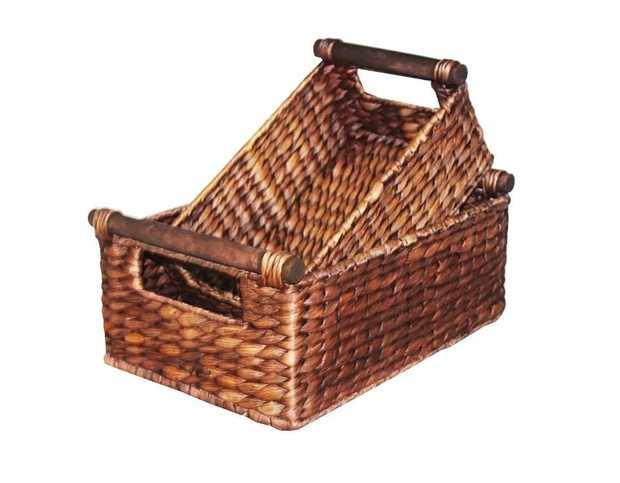
Vietnam is the strongest origin for water hyacinth and seagrass. That is not a marketing claim; it is where the raw material grows in commercial volume and where the weaving tradition sits. The Mekong Delta produces the world's supply of handwoven water hyacinth product at retail scale. If your program is water hyacinth basketry, seagrass trays, or mixed natural-fibre décor, Vietnam is where you start.
Vietnam also holds a significant tariff advantage for US buyers. Handwoven baskets classified under HS 4602 enter the US at near-zero MFN duty from Vietnam. Comparable Chinese product carries Section 301 duty on top of MFN. For a US buyer running a home décor program at any real volume, that gap alone shifts the sourcing decision.
Weakness to know about: Vietnam is a fragmented landscape. There are thousands of small workshops and only a fraction have the QC discipline, English communication, and export documentation to run a retail program. Choosing the wrong Vietnamese supplier is easy. Choosing the right one is what an intermediary is for.
Where China still wins
China wins on unit price at very large volume, especially for wire-frame baskets, plastic-and-fibre hybrids, and metal-plus-natural pieces. Chinese factory scale can produce a mid-range storage basket cheaper than any Vietnamese village weaver, if you are the kind of buyer who orders 20,000 units per SKU and does not mind the piece being partly machine-assembled.
China also wins for buyers whose landed cost target is very tight and who are not shipping to the US. UK, EU, and Australian buyers see China's price without the Section 301 uplift, which changes the math.
Weakness to know about: quality consistency at the lower-cost tier varies. Retail buyers rotating out of China after 2020 cited two things most often: erratic batch-to-batch quality, and IP concerns when Chinese suppliers introduced buyer designs as their own stock line. Both are still real in 2026.
Where Indonesia wins
Indonesia is the origin for rattan. It has the largest rattan pole supply in Southeast Asia and the largest cluster of rattan-furniture producers. If your program is rattan chairs, rattan bar stools, rattan-and-teak accents, or rattan pole planters, Indonesia is where the depth is.
Indonesia also has genuine craft heritage. Java, Bali, and Sulawesi carry centuries of woven-fibre tradition. Buyers who want provenance stories, hand-carved detail, and boutique-scale program pieces often find their best supplier in Indonesia.
Weakness to know about: lead times run longer than Vietnam or China. Communication with smaller Indonesian producers can be slower. And for water hyacinth specifically, Indonesia produces some, but not at Vietnam's volume or price band.
How to think about your program
US retail, natural-fibre décor, price-sensitive: Vietnam. The tariff gap makes it the default.
UK or EU retail, natural-fibre décor: Vietnam wins on craft, China wins on price at very high volume. Compare landed cost against a real container quote, not a spreadsheet estimate.
Rattan furniture at any scale: Indonesia is the deep bench. Vietnam can quote rattan but the pole supply is Indonesia's.
Multi-category program (baskets + furniture + accents): Vietnam for the baskets and accents, Indonesia for the rattan furniture. Do not force one origin to cover both.
What actually moved from 2020 to 2026
The visible shift in HS 4602 (plaiting materials, natural-fibre articles) trade data over the past six years:
- US imports from Vietnam grew significantly as retailers rotated program share out of China. Vietnam is now the number one origin for US buyers of handwoven natural-fibre baskets.
- Germany became the number two importer across Europe for HS 4602, with growth from EU-based home décor chains and e-commerce platforms.
- China's share of low-mid tier basketry compressed, though it retained volume in the metal-framed and hybrid categories where factory scale matters more.
- Indonesia held steady on rattan and picked up modest gains where buyers wanted "not China" provenance.
The macro pattern for buyers under 2026 conditions: diversify away from single-country dependence, add Vietnam to any handicraft mix that does not already include it, keep China for factory-scale hybrid product, and treat Indonesia as the rattan specialist.
Sourcing is not a country decision. It is a category-by-category decision that happens to have a country attached.
The buyers I see making the strongest programs pick the country per category, not per program. They will run baskets from Vietnam, rattan chairs from Indonesia, and a metal-frame line from China in the same season, and their landed cost per category is better than a single-origin equivalent would be.